
Managing business finances requires more than just tracking sales and expenses. A monthly bank statement serves as the official record of all financial transactions, providing crucial documentation for accounting, tax preparation, and strategic decision-making. Understanding how to read, analyze, and utilize these statements effectively can transform them from routine paperwork into powerful financial management tools that drive business growth and maintain fiscal health.
Understanding the Structure of Your Monthly Bank Statement
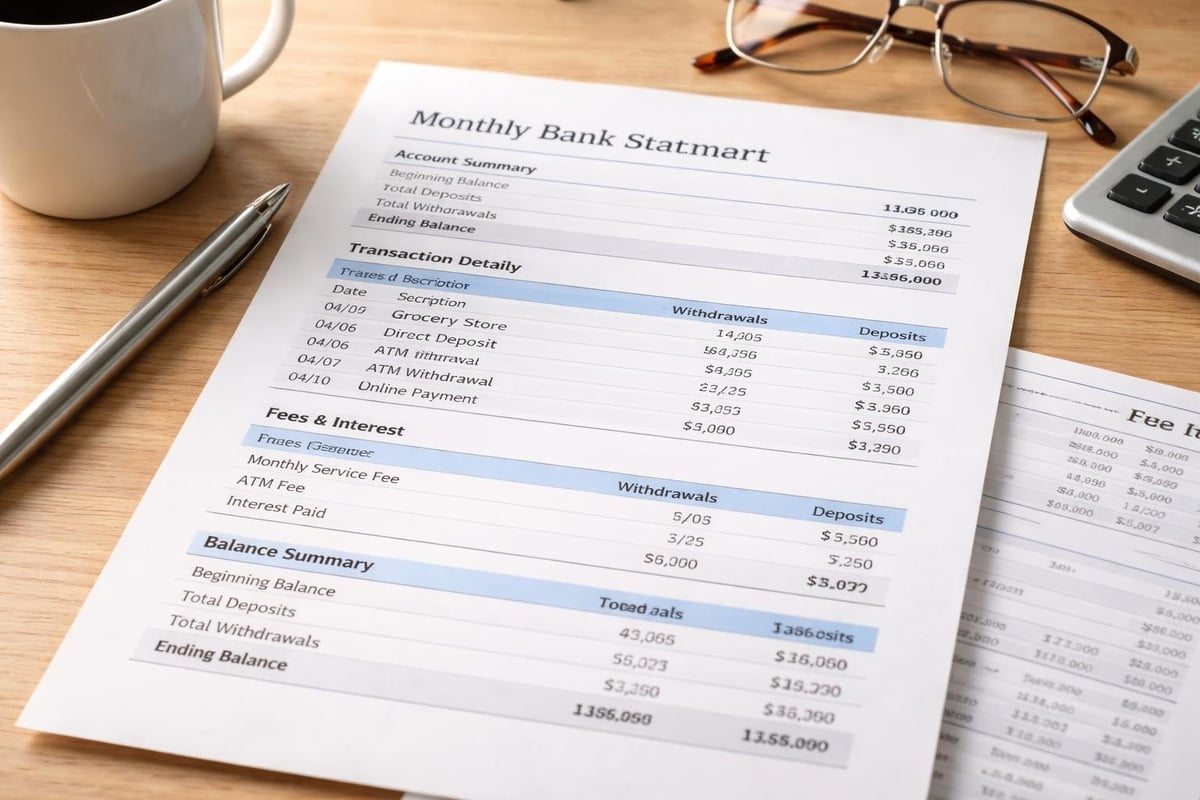
Every monthly bank statement follows a standardized format designed to provide comprehensive financial information. The document typically begins with account holder details, including your business name, address, and account number. This header section also displays the statement period, usually covering a full calendar month, along with your beginning and ending balances.
The main body contains a chronological listing of all transactions. Each entry includes the transaction date, description, reference number, and the amount debited or credited. What is a bank statement can help you understand these components in greater detail. Financial institutions organize this information to help businesses track cash flow and identify spending patterns.
Key Components Every Statement Includes
Account summary information appears prominently at the top, showing:
- Opening balance from the previous statement period
- Total deposits and credits for the current period
- Total withdrawals and debits for the current period
- Ending balance as of the statement closing date
- Available balance (if different from the ending balance)
Additional sections may include interest earned, service fees charged, and minimum balance requirements. Some banks also provide year-to-date summaries and comparative data from previous periods.
Why Your Monthly Bank Statement Matters for Business
Financial institutions provide these documents for important legal and practical reasons. According to regulatory requirements, banks must send statements to account holders who have electronic fund transfers, ensuring transparency in financial transactions.
For business owners, a monthly bank statement serves multiple critical functions. The document acts as an independent verification of your internal bookkeeping, helping identify discrepancies between your records and the bank's official ledger. This reconciliation process catches errors, unauthorized transactions, and accounting mistakes before they compound into larger problems.
Tax compliance represents another crucial application. The Internal Revenue Service accepts bank statements as supporting documentation for business deductions and income reporting. During audits or loan applications, these statements provide third-party verification of financial activity that carries more weight than self-reported records.
Fraud Detection and Security
Monitoring your monthly bank statement helps protect against financial fraud. Regular review allows you to spot unauthorized transactions quickly, maximizing your chances of recovering funds and limiting liability. Banks are required to include specific information that aids in identifying suspicious activity.
Common fraud indicators include:
- Unfamiliar merchant names or transaction descriptions
- Duplicate charges for the same amount
- Small "test" transactions that precede larger fraudulent charges
- Withdrawals from unexpected locations or at unusual times
- Subscription charges for services you didn't authorize
Response time matters. Most banks require fraud reports within 60 days of the statement date to guarantee full protection under federal regulations. Businesses that delay reviewing their monthly bank statement risk absorbing losses from fraudulent transactions.
How to Read and Analyze Transaction Details
The transaction section requires careful attention to extract maximum value. Each line item tells a story about your business operations, cash flow timing, and spending habits. Learning to interpret this information transforms raw data into actionable business intelligence.
Transaction descriptions vary by financial institution and merchant. Some entries provide clear details, while others use abbreviated codes or reference numbers. Understanding these descriptions helps categorize expenses accurately and identify trends over time.
Decoding Transaction Types
| Transaction Type | Description | Impact on Balance |
|---|---|---|
| ACH Debit | Automated Clearing House withdrawal | Decreases |
| ACH Credit | Electronic deposit | Increases |
| Wire Transfer | Direct bank-to-bank transfer | Varies |
| Check Payment | Traditional paper check clearance | Decreases |
| ATM Withdrawal | Cash withdrawal from machine | Decreases |
| Debit Card Purchase | Point-of-sale transaction | Decreases |
| Fee Assessment | Bank service charge | Decreases |
| Interest Payment | Earned account interest | Increases |
Posted versus pending transactions create another layer of complexity. Your monthly bank statement shows only posted transactions that have fully cleared. This distinction explains why your statement balance might differ from your current online banking balance, which includes pending items still processing through the banking system.

Reconciling Your Statement with Internal Records
Statement reconciliation represents one of the most important accounting tasks for any business. This process involves comparing your monthly bank statement against your internal bookkeeping to verify accuracy and identify discrepancies. Regular reconciliation catches errors early, prevents overdrafts, and maintains accurate financial records.
The reconciliation process follows a systematic approach. Begin by gathering your monthly bank statement, internal transaction records, and the previous month's reconciliation report. Compare each bank transaction against your records, marking items that match and investigating those that don't.
Step-by-Step Reconciliation Process
- Compare opening balances between your records and the bank statement
- Mark off matching transactions in both sets of records
- Identify outstanding checks written but not yet cleared
- Note deposits in transit recorded but not yet posted
- Account for bank fees that may not appear in your records
- Investigate discrepancies until all differences are explained
- Adjust internal records for legitimate bank charges or errors
- Document the reconciliation with notes explaining any adjustments
Converting PDF bank statements to spreadsheet format can streamline this process significantly. Tools that convert PDF bank statements to usable spreadsheets enable easier sorting, filtering, and comparison of transaction data across multiple periods.
Common Fees and Charges Explained
Your monthly bank statement typically includes various fees that impact your bottom line. Understanding these charges helps minimize unnecessary costs and negotiate better banking terms. Service fees vary widely between institutions and account types, making it essential to review the fee schedule regularly.
Monthly maintenance fees represent the most common charge, assessed for basic account services. Many banks waive this fee if you maintain minimum balances or meet transaction requirements. Overdraft fees occur when transactions exceed available funds, often carrying steep penalties that compound if multiple transactions process while the account remains negative.
Additional charges may include:
- Wire transfer fees for incoming and outgoing transfers
- ATM fees for using out-of-network machines
- Paper statement fees if you opt out of electronic delivery
- Stop payment fees for canceling checks
- Returned item fees for bounced checks or failed ACH transactions
- Cashier's check or money order fees
Analyzing fee patterns on your monthly bank statement reveals opportunities for cost reduction. If ATM fees appear frequently, switching to a bank with a larger network makes sense. Multiple overdraft charges suggest the need for better cash flow management or overdraft protection services.
Digital Statements Versus Paper Statements
The banking industry has shifted dramatically toward electronic delivery of monthly bank statement documents. Wikipedia notes this transition reflects broader digitalization trends in financial services. Both formats contain identical information, but electronic statements offer several advantages for business users.
Environmental impact aside, digital statements provide superior accessibility and organization. Electronic files are searchable, making it simple to find specific transactions across multiple months. Cloud storage ensures statements remain available even if physical records are lost or damaged. Many accounting software platforms integrate directly with electronic statements, automating data entry and reconciliation tasks.
Comparing Delivery Methods
| Feature | Electronic Statements | Paper Statements |
|---|---|---|
| Delivery Speed | Instant availability | 3-7 business days |
| Storage Cost | Minimal to none | Filing cabinets, space |
| Searchability | Full text search | Manual review only |
| Environmental Impact | Negligible | Paper, printing, shipping |
| Security Risk | Encryption, passwords | Physical theft, loss |
| Integration | Direct data import | Manual data entry |
| Typical Cost | Free | Often $2-5 per month |
Security considerations differ between formats. Paper statements risk interception during mail delivery or theft from unsecured locations. Electronic statements face cybersecurity threats like phishing or unauthorized access to email accounts. Using strong passwords, two-factor authentication, and secure storage protects digital financial documents effectively.

Leveraging Statement Data for Business Intelligence
Beyond basic reconciliation, your monthly bank statement contains valuable data for strategic decision-making. Transaction patterns reveal seasonal business cycles, customer payment behavior, and spending trends that inform budgeting and forecasting. Analyzing this information systematically transforms historical records into forward-looking insights.
Cash flow analysis starts with your statement data. Tracking the timing of deposits and withdrawals helps identify periods when working capital runs tight. This knowledge enables proactive measures like securing lines of credit before cash crunches occur or adjusting payment terms with vendors and customers to smooth cash flow throughout the year.
Expense categorization based on monthly bank statement data supports better budget development. Grouping transactions by vendor, category, or department reveals where money actually flows versus where budgets allocate it. Significant variances indicate areas requiring tighter control or budget adjustments to reflect operational reality.
Creating Financial Reports from Statement Data
Extracting transaction data into spreadsheet format enables powerful analysis. Pivot tables, charts, and formulas transform raw monthly bank statement information into management reports that drive decision-making. For businesses managing multiple accounts or locations, a bank statement analyzer can automate much of this analysis.
Key metrics to track include:
- Average daily balance across statement periods
- Transaction frequency by category or vendor
- Seasonal variation in deposits and withdrawals
- Fee costs as a percentage of total transactions
- Time between invoice dates and payment clearance
Trend analysis across multiple statement periods identifies patterns invisible in single-month reviews. Comparing year-over-year data for the same month eliminates seasonal distortions, providing clearer pictures of growth or contraction in specific areas.
Best Practices for Statement Management
Effective monthly bank statement management requires consistent processes and attention to detail. Establishing routines ensures no statement goes unreviewed and all financial records remain current and accurate. Small businesses and freelancers particularly benefit from structured approaches to statement handling.
Timing matters. Review your monthly bank statement within five business days of receiving it. Fresh memory of recent transactions makes reconciliation faster and more accurate. Early review also maximizes the window for disputing errors or reporting fraud under banking regulations.
Organize statements systematically, whether digitally or physically. Create a filing system by account type and date, making historical statements easy to locate when needed for tax preparation, audits, or reference. Digital statements should be backed up to multiple locations, including cloud storage and local drives, protecting against data loss.
For freelancers and small business owners managing multiple income streams, maintaining separate business and personal accounts simplifies statement review and tax preparation. Commingling transactions complicates reconciliation and creates potential issues during IRS audits.
Statement Retention Requirements and Best Practices
Legal and practical considerations dictate how long to retain monthly bank statement records. The IRS generally requires maintaining supporting financial documents for three years from the tax return filing date. However, some situations require longer retention periods, making seven years the commonly recommended standard for business records.
Retention requirements vary by situation:
- Standard business records: 7 years minimum
- Statements showing depreciable asset purchases: Until 7 years after asset disposal
- Employment tax records: 4 years after tax due date
- Statements supporting bad debt deductions: 7 years from deduction date
- Fraud or unfiled returns: Indefinite retention recommended
Beyond tax compliance, statements support other business needs. Loan applications require historical financial statements, often covering 2-3 years. Investor due diligence, business sales, and partnership disputes all benefit from comprehensive statement archives extending beyond minimum legal requirements.
Secure storage protects sensitive financial information. Physical statements require locked filing cabinets or secure storage facilities. Digital files need encryption, password protection, and access controls limiting who can view confidential financial data. The security measures protecting digital financial documents should match those used by financial institutions themselves.
Integration with Accounting Software
Modern accounting platforms streamline monthly bank statement reconciliation through automated data feeds and matching algorithms. Connecting your bank accounts to software like QuickBooks, Xero, or FreshBooks eliminates manual data entry and reduces reconciliation time significantly. However, understanding the underlying process remains important even when automation handles routine tasks.
Bank feeds import transactions automatically, but they still require review and categorization. Software suggests categories based on previous assignments and merchant data, but human oversight ensures accuracy. Monthly reconciliation remains necessary to verify that automated feeds captured all transactions and applied categories correctly.
When working with PDF statements rather than direct feeds, conversion to spreadsheet format enables import into accounting software. Platforms like Xero support various import formats, but properly structured data ensures smooth integration without errors or duplicate entries.
Automation Benefits and Limitations
| Aspect | Automated Processing | Manual Processing |
|---|---|---|
| Speed | Minutes per statement | Hours per statement |
| Error Rate | Low for recurring items | Higher due to fatigue |
| Learning Curve | Moderate initial setup | Minimal training needed |
| Cost | Software subscription fees | Staff time and labor |
| Customization | Template-based rules | Fully flexible approach |
| Audit Trail | Detailed system logs | Manual documentation |
Quality control remains essential regardless of automation level. Even sophisticated algorithms miss nuances that human reviewers catch. Unusual transactions, vendor name changes, or duplicate charges require judgment that software alone cannot provide reliably.
Understanding and effectively utilizing your monthly bank statement transforms routine financial compliance into strategic advantage. These documents provide the foundation for accurate bookkeeping, tax compliance, fraud prevention, and business intelligence when properly analyzed and managed. For businesses handling numerous transactions across multiple accounts, converting PDF statements to spreadsheet format eliminates manual data entry while maintaining accuracy. Bank Statement Boss uses AI technology to convert PDF bank and credit card statements into spreadsheets with 99% accuracy, integrating seamlessly with major accounting platforms while maintaining bank-level security throughout the conversion process.