
Financial data sits at the heart of every business decision, yet many organizations struggle to extract meaningful insights from their monthly bank statements. A bank statement analyzer has become an essential tool for businesses, accountants, and financial professionals who need to transform raw transaction data into actionable intelligence. These sophisticated systems automate the process of reviewing, categorizing, and interpreting banking transactions, eliminating hours of manual work while improving accuracy and compliance. As we move further into 2026, the technology behind statement analysis continues to evolve, offering unprecedented capabilities for financial management and strategic planning.
Understanding Bank Statement Analysis
A bank statement analyzer processes financial documents to extract, organize, and interpret transaction data. These tools serve multiple purposes, from basic bookkeeping to complex fraud detection and cash flow forecasting. The fundamental value proposition centers on converting unstructured PDF documents into structured, searchable data that financial systems can process.
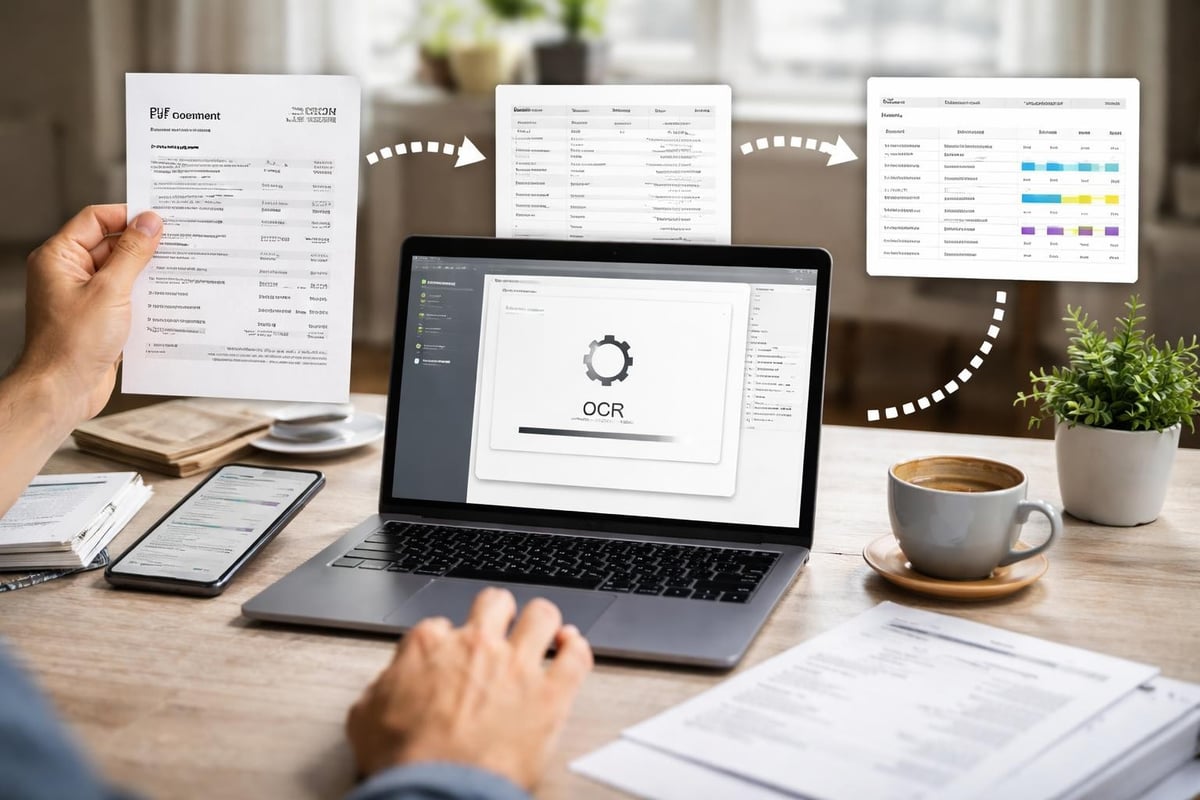
Traditional manual analysis of bank statements required hours of data entry, category assignment, and reconciliation work. Modern analyzer tools leverage artificial intelligence and optical character recognition (OCR) technology to automate these tasks with remarkable accuracy. The shift from manual to automated analysis represents more than just time savings, it fundamentally changes how businesses approach financial oversight.
Key Components of Statement Analysis
Every effective bank statement analyzer incorporates several critical capabilities that determine its utility and accuracy:
- Data extraction pulls transaction details, dates, amounts, and descriptions from PDF documents
- Transaction categorization assigns each entry to appropriate accounting categories
- Duplicate detection identifies and flags potentially redundant entries
- Pattern recognition spots unusual activity, trends, or anomalies
- Multi-format support handles statements from various financial institutions
- Export functionality prepares data for integration with accounting platforms
The sophistication of these components varies significantly across different solutions. Enterprise-grade analyzers incorporate machine learning algorithms that improve categorization accuracy over time, while basic tools rely on predefined rules and manual corrections.
Business Applications and Use Cases
Financial professionals across industries deploy bank statement analyzers for distinct purposes, each requiring different feature sets and capabilities. Understanding these applications helps organizations select tools that align with their specific needs.
Accounting and Bookkeeping
Accounting firms process hundreds of client statements monthly, making automation not just convenient but necessary for profitability. A robust bank statement analyzer reduces the time accountants spend on data entry by up to 85%, allowing them to focus on advisory services and strategic planning. For businesses choosing the right banking partner for freelancers, statement analysis becomes even more critical as transaction volumes grow.
The integration between statement analyzers and platforms like QuickBooks or Xero bank feeds creates seamless workflows. Rather than manually importing transactions, professionals can batch-process statements and push categorized data directly into their accounting systems.
Loan and Credit Applications
Lenders require comprehensive financial documentation when evaluating creditworthiness. Applicants often submit months or years of bank statements as proof of income, expense patterns, and financial stability. Manual review of these documents consumes significant underwriting resources and introduces potential for human error.
| Analysis Type | Manual Review Time | Automated Analysis Time | Accuracy Rate |
|---|---|---|---|
| Income Verification | 45-60 minutes | 3-5 minutes | 99%+ |
| Expense Categorization | 60-90 minutes | 5-8 minutes | 95-99% |
| Fraud Detection | 30-45 minutes | 2-3 minutes | 97%+ |
| Cash Flow Analysis | 90-120 minutes | 8-12 minutes | 98%+ |
Financial institutions implementing automated statement analysis report dramatic reductions in processing time while maintaining or improving accuracy standards. The technology identifies income sources, calculates debt-to-income ratios, and flags potential discrepancies that warrant further investigation.
Fraud Detection and Compliance
Security professionals utilize bank statement analyzers to identify suspicious patterns that might indicate fraudulent activity. These systems scan for unusual transaction sequences, unexpected merchant categories, or amounts that deviate from historical norms.
Compliance teams benefit equally from automated analysis capabilities. The IRS requires businesses to maintain accurate financial records, including detailed transaction histories. A bank statement analyzer creates auditable trails, categorizes expenses for tax purposes, and generates reports that satisfy regulatory requirements.
Essential Features and Technology
The effectiveness of any bank statement analyzer depends on its underlying technology stack and feature implementation. Organizations evaluating these tools should prioritize capabilities that address their specific workflow requirements.
Artificial Intelligence and Machine Learning
Modern analyzers employ AI algorithms that continuously improve categorization accuracy. These systems learn from user corrections, adapting to industry-specific terminology and unique business transaction patterns. The machine learning component distinguishes advanced solutions from basic OCR tools that rely solely on template matching.
Natural language processing (NLP) enhances description interpretation, understanding context beyond simple keyword matching. When a transaction reads "AMZN Mktp US," the system recognizes this as an Amazon Marketplace purchase and categorizes it appropriately based on historical patterns and user preferences.
Data Security and Privacy
Financial data represents one of the most sensitive information categories businesses handle. Enterprise-grade bank statement analyzers implement bank-level security protocols including:
- 256-bit encryption for data transmission and storage
- Zero-knowledge architecture where service providers cannot access unencrypted data
- SOC 2 Type II compliance demonstrating rigorous security controls
- Automatic data deletion options following processing completion
- Multi-factor authentication for user access controls
Organizations should verify security certifications and review security documentation before uploading sensitive financial documents to any analysis platform.

Implementation and Integration
Successfully deploying a bank statement analyzer requires strategic planning beyond simple tool selection. Organizations must consider existing workflows, staff training requirements, and technical integration points.
Accounting Platform Compatibility
The value of statement analysis multiplies when data flows seamlessly into existing accounting systems. Leading analyzers offer direct integrations or standardized export formats compatible with major platforms. Services that convert PDF bank statements to spreadsheet formats enable compatibility with virtually any accounting software that accepts CSV or Excel imports.
Integration approaches vary by platform:
- Direct API connections push categorized transactions automatically into accounting software
- Standardized export formats generate files matching platform import specifications
- Manual review interfaces allow verification before final data transfer
- Batch processing capabilities handle multiple statements simultaneously
- Custom field mapping aligns analyzer outputs with specific chart of accounts structures
Workflow Optimization Strategies
Implementing a bank statement analyzer presents an opportunity to redesign financial workflows from the ground up. Rather than simply automating existing manual processes, forward-thinking organizations reimagine how financial data moves through their operations.
The most effective implementations establish clear quality control checkpoints. While AI-powered analysis achieves impressive accuracy rates, human oversight remains essential for unusual transactions or first-time merchant identifications. Designating specific team members to review flagged items maintains data integrity without sacrificing automation benefits.
For businesses operating in eCommerce spaces, connecting financial analysis with operational metrics provides deeper insights. Merchants active in communities like Talk Shop often seek ways to correlate banking transactions with platform-specific metrics, creating comprehensive performance dashboards that inform strategic decisions.
Advanced Analysis Capabilities
Beyond basic transaction categorization, sophisticated bank statement analyzers offer analytical features that transform historical data into forward-looking intelligence.
Cash Flow Forecasting
Predictive analytics examine transaction patterns to project future cash positions. These forecasts account for seasonal variations, recurring payments, and growth trends evident in historical data. Business owners gain visibility into potential cash shortages weeks before they occur, enabling proactive financial management.
The forecasting algorithms consider multiple variables simultaneously:
- Historical transaction timing and amounts
- Recurring payment schedules and vendor patterns
- Seasonal revenue fluctuations based on prior years
- Pending transactions and scheduled transfers
- Industry benchmarks and economic indicators
Spending Pattern Analysis
Detailed categorization enables businesses to understand exactly where money flows. A comprehensive bank statement analyzer breaks down expenses by vendor, category, department, or project, revealing optimization opportunities that aggregate statements obscure.
| Expense Category | Monthly Average | Annual Trend | Optimization Potential |
|---|---|---|---|
| Software Subscriptions | $2,847 | +23% | High - audit for unused licenses |
| Office Supplies | $456 | -8% | Low - stable and decreasing |
| Marketing | $8,921 | +47% | Medium - evaluate ROI by channel |
| Professional Services | $3,200 | +12% | Medium - consider in-house options |
This granular visibility empowers data-driven decision-making. Controllers identify subscription services no longer providing value, negotiate better vendor terms based on spending volume, or reallocate budgets toward higher-performing categories.
Multi-Entity Consolidation
Organizations managing multiple bank accounts, business entities, or client portfolios benefit from consolidation features. Advanced analyzers aggregate data across accounts while maintaining individual transaction attribution. This capability proves invaluable for holding companies, accounting firms serving multiple clients, or businesses operating subsidiary entities.
Consolidated reporting provides enterprise-wide visibility while preserving the detail necessary for entity-specific analysis. Financial executives review overall organizational health while department managers access reports filtered to their specific areas of responsibility.

Selecting the Right Analyzer
The market offers numerous bank statement analyzer options, from free basic tools to enterprise platforms with comprehensive feature sets. Evaluation criteria should align with organizational size, transaction volume, and specific use cases.
Evaluation Framework
Organizations should assess potential solutions across multiple dimensions:
Accuracy and reliability matter most, as errors in financial data create cascading problems through accounting, tax preparation, and business decision-making. Request demonstration data showing real-world accuracy rates, not just theoretical capabilities.
Processing speed impacts workflow efficiency, particularly for organizations handling high volumes. Analyzers should process typical statement PDFs in seconds, not minutes, maintaining productivity during peak periods.
Scalability ensures the solution grows with organizational needs. Systems that handle ten statements monthly may struggle with hundreds, making future capacity an important selection criterion.
Cost structure varies dramatically across solutions. Some charge per statement processed, others offer monthly subscriptions with volume tiers, and enterprise platforms may require custom pricing. Calculate total cost of ownership including implementation, training, and ongoing support.
Common Pitfalls to Avoid
Organizations frequently encounter challenges when implementing statement analysis technology. Awareness of common pitfalls enables proactive mitigation:
- Underestimating training requirements leads to poor adoption and continued manual processes
- Neglecting data quality checks allows errors to propagate through accounting systems
- Ignoring integration complexity creates data silos and manual transfer points
- Overlooking security implications exposes sensitive financial information to unnecessary risk
- Focusing solely on price results in feature-limited solutions that fail to meet actual needs
Successful implementations begin with clear requirement definitions, involve key stakeholders in selection processes, and allocate sufficient resources for proper deployment and training.
Future Trends in Statement Analysis
The technology underlying bank statement analyzers continues advancing rapidly, with several emerging trends poised to reshape the landscape in coming years.
Real-Time Analysis and Monitoring
Traditional statement analysis operates on monthly cycles, processing documents after the statement period closes. Emerging capabilities enable real-time transaction monitoring through direct bank feed integrations. Rather than waiting for monthly PDFs, systems continuously ingest and categorize transactions as they occur.
This shift toward real-time analysis provides immediate visibility into financial positions, fraud detection that identifies suspicious activity within minutes rather than weeks, and cash flow monitoring that updates constantly rather than monthly.
Enhanced Predictive Capabilities
Machine learning models grow more sophisticated with each training cycle, improving not just categorization accuracy but predictive power. Future analyzers will forecast cash flow with greater precision, identify optimization opportunities proactively, and recommend specific actions based on pattern analysis.
These predictive capabilities extend beyond simple trend projection. Advanced models consider external factors like economic indicators, industry benchmarks, and seasonal patterns specific to business types, delivering insights that inform strategic planning.
Blockchain and Distributed Ledger Integration
As blockchain technology matures, statement analyzers may incorporate distributed ledger capabilities for enhanced security, immutable audit trails, and automated reconciliation across parties. These integrations remain largely theoretical in 2026 but represent significant long-term potential for financial data management.
A bank statement analyzer transforms financial document processing from a time-consuming manual task into an automated, accurate workflow that delivers strategic insights alongside basic categorization. The technology addresses critical needs across accounting, lending, compliance, and business intelligence applications. Bank Statement Boss provides AI-powered conversion of PDF bank statements into spreadsheet formats with 99% accuracy, offering bank-level security and compatibility with major accounting platforms to streamline your financial data management.