
Managing financial records requires understanding the critical relationship between statement and documents in modern business operations. Every financial transaction generates both primary statements and supporting documentation that must work together to create a complete, verifiable record. This interconnected system forms the foundation of accurate accounting, regulatory compliance, and strategic decision-making for businesses of all sizes.
The Foundation of Statement and Documents
Financial statement and documents serve distinct yet complementary roles in business record-keeping. A statement provides a summary of transactions over a specific period, while supporting documents offer detailed evidence for each entry. Understanding this relationship is essential for maintaining accurate financial records and preparing for audits.
Primary Statements vs. Supporting Documentation
Bank statements, credit card statements, and investment statements represent the primary record layer. These documents typically arrive monthly and provide an official summary from the financial institution. They list all transactions chronologically with dates, amounts, and brief descriptions.
Supporting documents include:
- Receipts from purchases and sales
- Invoices for services rendered or received
- Contracts and purchase orders
- Deposit slips and wire transfer confirmations
- Tax forms and withholding certificates
The combination of statement and documents creates an audit trail that validates every financial entry. Without both components, businesses face significant challenges during tax preparation, financial audits, and regulatory reviews.

Authoritative Sources in Financial Documentation
When evaluating the validity of financial statement and documents, understanding what constitutes an authoritative source becomes paramount. Financial institutions hold recognized authority because they maintain direct transaction records and operate under strict regulatory oversight.
Characteristics of Authoritative Financial Documents
Authoritative sources in finance share common characteristics that establish their credibility. These sources must be original, verifiable, and issued by recognized institutions with proper licensing and regulatory compliance.
| Characteristic | Financial Statements | Supporting Documents |
|---|---|---|
| Issuing Authority | Banks, credit unions, investment firms | Vendors, customers, service providers |
| Regulatory Oversight | FDIC, SEC, state banking authorities | Varies by industry |
| Verification Method | Direct institution contact | Cross-reference with statements |
| Legal Standing | Primary evidence | Corroborating evidence |
| Retention Requirement | 3-7 years | 3-7 years |
Financial professionals must verify that each piece of statement and documents comes from legitimate sources. This verification process protects against fraud and ensures accuracy in financial reporting. Banks and credit card companies provide monthly statements that serve as the primary authoritative record, while receipts and invoices from third parties require additional verification steps.
Digital Transformation of Statement and Documents
The shift from paper to digital formats has revolutionized how businesses manage statement and documents. PDF statements now dominate financial communications, offering security advantages while presenting new challenges for data extraction and analysis.
Converting PDF Statements to Usable Data
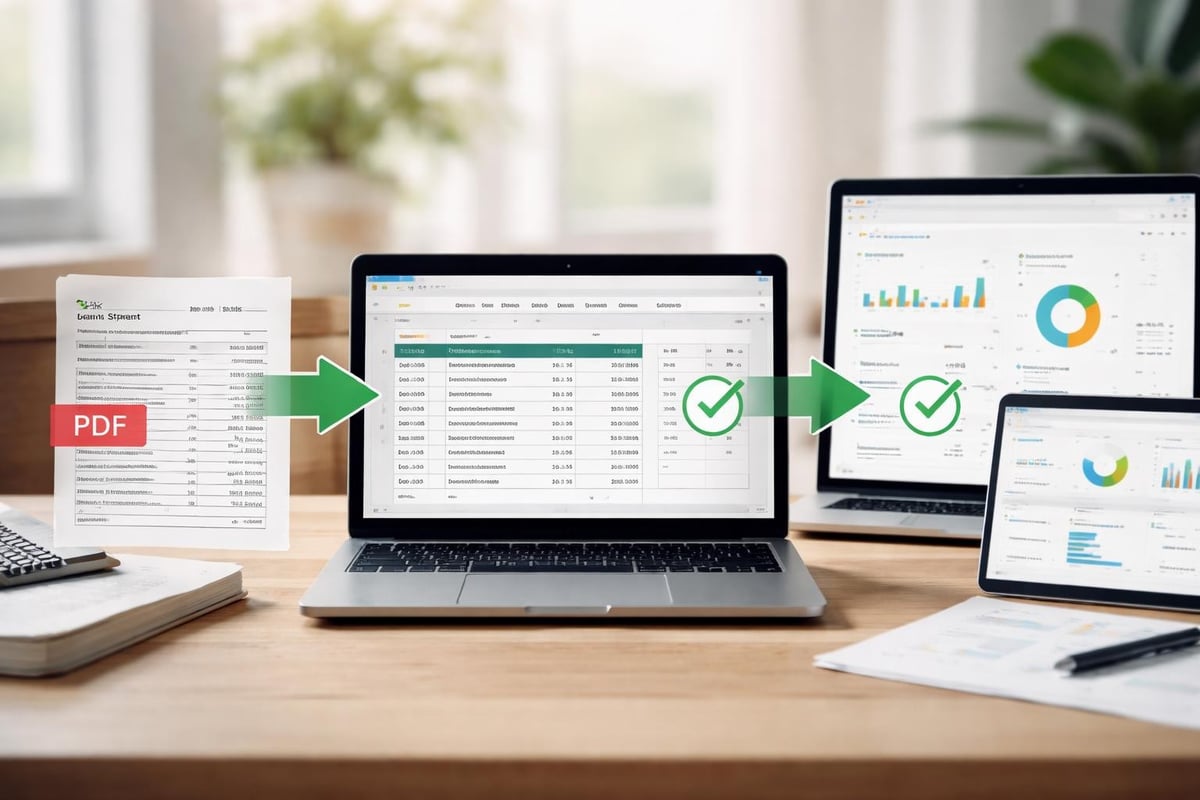
Most financial institutions deliver statement and documents in PDF format, which maintains visual fidelity but limits data manipulation. Businesses need transaction data in spreadsheet formats to integrate with accounting systems, perform analysis, and generate reports. Converting PDF bank statements to usable spreadsheets has become essential for efficient financial management.
Modern conversion processes involve several steps:
- Document reception and verification - Receiving official PDF statements from financial institutions
- Data extraction - Pulling transaction details, dates, amounts, and descriptions
- Format standardization - Converting data into consistent spreadsheet columns
- Quality assurance - Verifying accuracy against original PDF
- System integration - Importing cleaned data into accounting platforms
This transformation streamlines the workflow between statement and documents while maintaining data integrity. Automated conversion reduces manual entry errors and saves significant time compared to typing each transaction individually.
Organizing Statement and Documents for Compliance
Proper organization of financial statement and documents goes beyond simple filing. Businesses must implement systems that support quick retrieval, maintain security, and satisfy regulatory requirements. The organization strategy affects audit readiness, tax preparation efficiency, and overall financial management effectiveness.
Best Practices for Document Management
A comprehensive approach to managing statement and documents includes both physical and digital components. Even businesses operating primarily in digital environments should maintain systematic organization protocols.
Physical document storage recommendations:
- Use fireproof filing cabinets for sensitive financial records
- Organize by year, then by account or vendor
- Maintain separate files for different statement types
- Label clearly with account numbers and date ranges
- Store off-site backups for disaster recovery
Digital document management strategies:
- Implement consistent naming conventions (YYYY-MM-AccountType-Institution)
- Create folder hierarchies mirroring accounting categories
- Utilize cloud storage with encryption for accessibility and security
- Maintain version control for amended documents
- Schedule regular backups to multiple locations
The security measures applied to digital statement and documents should match or exceed those for physical records. Encryption, access controls, and audit logging protect sensitive financial information from unauthorized access.

Verification and Reconciliation Processes
Matching statement and documents through reconciliation represents a critical control mechanism for financial accuracy. This process identifies discrepancies, catches errors, and detects potential fraud before issues compound over multiple periods.
Monthly Reconciliation Workflows
Statement reconciliation requires systematic comparison between bank statements and internal accounting records. The process ensures that all transactions appear correctly in both systems and identifies timing differences, bank errors, or unauthorized transactions.
| Reconciliation Step | Activity | Common Issues |
|---|---|---|
| Gather Documents | Collect bank statement and internal ledger | Missing statements, incomplete records |
| Compare Beginning Balance | Verify starting point matches | Prior period errors, unreconciled items |
| Mark Cleared Items | Check off matching transactions | Timing differences, duplicate entries |
| Identify Discrepancies | List unmatched items | Bank fees, errors, fraudulent charges |
| Make Adjustments | Record necessary corrections | Journal entries, error reversals |
| Verify Ending Balance | Confirm reconciliation complete | Mathematical errors, missed items |
Regular reconciliation of statement and documents prevents small errors from becoming major problems. Monthly reconciliation provides timely error detection, while quarterly or annual reviews may allow discrepancies to multiply.
Industry-Specific Statement Requirements
Different industries face unique requirements for managing statement and documents based on regulatory frameworks, business models, and transaction volumes. Understanding these variations helps businesses implement appropriate systems and avoid compliance issues.
Freelancers and Independent Contractors
Freelancers managing multiple client relationships and payment platforms must track statement and documents across numerous accounts. Each payment platform generates its own statement format, requiring reconciliation across PayPal, Stripe, direct deposits, and other payment methods. Selecting the right bank for freelancers with clear statement formats simplifies this tracking challenge.
E-commerce and Retail Businesses
Online sellers receive statement and documents from payment processors, marketplace platforms, and traditional banks. Amazon, eBay, Shopify, and similar platforms provide detailed transaction reports that must reconcile with bank deposits. The timing differences between sale dates, processing dates, and deposit dates create reconciliation complexity.
Professional Services Firms
Law firms, consulting agencies, and accounting practices generate extensive documentation beyond standard financial statements. Client trust accounts, retainer tracking, and billable hour documentation create additional layers of statement and documents requiring careful management and regular review.
Technology Integration for Statement Management
Modern accounting platforms integrate directly with financial institutions to import statement and documents automatically. This connectivity reduces manual data entry while maintaining accuracy and compliance standards.
Accounting Platform Compatibility
Businesses using platforms like QuickBooks, Xero, or FreshBooks benefit from understanding how statement and documents flow into their systems. Xero bank connections streamline data import, but many institutions still require manual statement uploads or conversion from PDF format.
The integration process typically follows these patterns:
- Direct bank feeds - Real-time transaction imports from supporting institutions
- File uploads - Manual import of downloaded statement files
- API connections - Programmatic data transfer between systems
- Converted data - Spreadsheet imports from converted PDF statements
Each method has advantages depending on the institution's technical capabilities and the business's accounting platform. Direct feeds offer convenience but may not support all banks. Manual uploads provide universal compatibility with proper file conversion.
Legal and Regulatory Considerations
Statement and documents serve as authoritative information in legal proceedings, tax audits, and regulatory examinations. Their legal standing requires businesses to maintain proper retention schedules and ensure document authenticity.
Retention Requirements by Document Type
Different statement and documents categories carry varying retention obligations based on tax law, industry regulations, and statute of limitations considerations.
Tax-related retention:
- Federal tax returns and supporting documents: 7 years minimum
- State tax filings: Check specific state requirements (typically 4-7 years)
- Payroll records and tax deposits: 4 years minimum
- Employment tax records: 4 years after due date or payment
Financial statement retention:
- Bank and credit card statements: 3-7 years
- Investment account statements: 7 years or until securities sold plus 3 years
- Retirement account statements: Permanently
- Loan documents: 7 years after final payment
Understanding the legal definition and applications of authoritative sources helps businesses determine which statement and documents require long-term preservation versus shorter retention periods.
Security Considerations for Digital Documents
Converting statement and documents to digital formats introduces cybersecurity responsibilities that extend beyond traditional filing cabinet locks. Digital security requires multiple protective layers to prevent unauthorized access, data breaches, and ransomware attacks.
Multi-Layer Security Approach
Comprehensive protection for digital statement and documents involves technical controls, procedural safeguards, and user education. Financial data attracts sophisticated attackers, making robust security essential rather than optional.
Technical security measures:
- Encryption for data at rest and in transit
- Multi-factor authentication for system access
- Automated backup systems with off-site storage
- Firewalls and intrusion detection systems
- Regular security updates and patch management
Procedural safeguards:
- Access control policies limiting data exposure
- Regular security audits and vulnerability assessments
- Incident response plans for breach scenarios
- Vendor security assessments for third-party services
- Employee background checks for financial access roles
Digital preservation of statement and documents offers advantages over physical storage when implemented with appropriate security controls. Redundant backups protect against loss from fire, flood, or hardware failure. Access logs create accountability that physical files cannot match.
Quality Control and Error Detection
Maintaining accuracy in statement and documents requires systematic quality control processes that catch errors before they affect financial reporting or compliance. Error detection becomes increasingly important as transaction volumes grow.
Common Statement Errors and Detection Methods
Financial statement and documents contain various error types ranging from simple data entry mistakes to complex reconciliation issues. Early detection prevents cascading problems across multiple accounting periods.
| Error Type | Detection Method | Prevention Strategy |
|---|---|---|
| Duplicate transactions | Automated duplicate checking | Transaction ID tracking |
| Missing transactions | Reconciliation variance analysis | Regular statement reviews |
| Incorrect amounts | Three-way matching (PO, receipt, invoice) | Automated data validation |
| Wrong account coding | Account balance anomaly detection | Chart of accounts training |
| Timing errors | Period-end cutoff procedures | Clear transaction date policies |
Businesses processing high transaction volumes benefit from automated error detection in their statement and documents workflows. Manual review alone cannot catch every discrepancy when handling thousands of monthly transactions. The combination of automated checks and human oversight provides optimal accuracy.
International Considerations
Companies operating across borders face additional complexity in managing statement and documents due to varying regulatory frameworks, currency conversions, and documentation standards. International operations multiply the types and formats of financial records requiring management.
Multi-Currency Statement Management
Businesses receiving statement and documents in multiple currencies must track both the original currency amounts and converted values. Exchange rate fluctuations create reconciliation challenges that domestic-only operations never encounter. Each foreign transaction requires documentation of the exchange rate used and the basis for currency conversion.
Understanding credibility evaluation criteria becomes particularly important when dealing with international financial institutions where standards and oversight vary significantly between jurisdictions.
Effective management of statement and documents forms the backbone of sound financial operations, from basic bookkeeping through complex regulatory compliance. The transformation from paper to digital formats has created both opportunities for efficiency and new challenges requiring proper tools and processes. Bank Statement Boss simplifies this critical workflow by converting PDF bank and credit card statements into spreadsheet formats with exceptional accuracy, enabling seamless integration with your accounting systems while maintaining bank-level security throughout the process.