
Understanding my bank statement is fundamental to maintaining financial health and making informed decisions about money management. Each month, financial institutions provide these detailed records of account activity, yet many individuals overlook their importance or struggle to interpret the information correctly. A comprehensive understanding of bank statements enables better budgeting, fraud detection, and financial planning while providing the documentation necessary for tax preparation, loan applications, and expense tracking.
Understanding the Essential Components of My Bank Statement
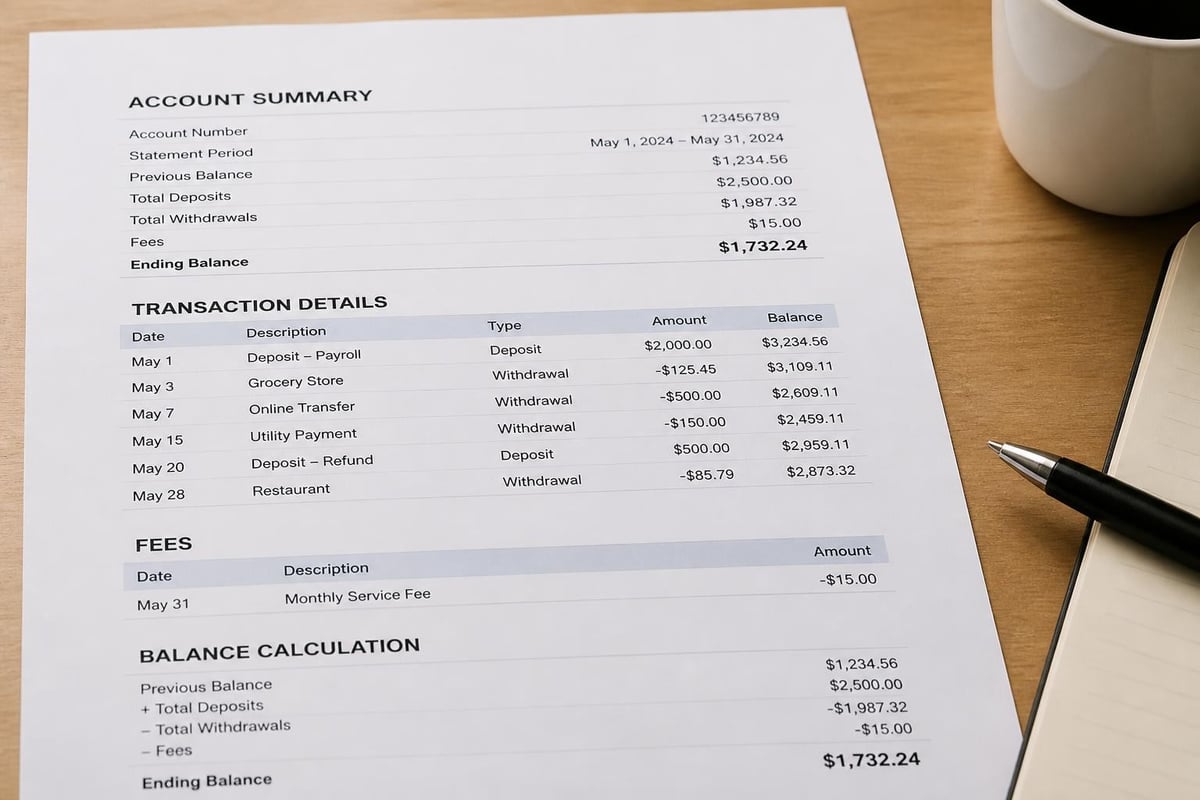
Every bank statement contains standardized elements that provide a complete picture of account activity during a specific period. The header section displays critical account information including the account holder's name, address, account number, and the statement period dates. This information confirms the account ownership and timeframe covered by the document.
The key sections found on my bank statement include:
- Account summary with beginning and ending balances
- Detailed transaction history listing all deposits and withdrawals
- Fee assessments and interest calculations
- Daily balance information
- Contact information for customer service
The transaction section represents the core of my bank statement, listing every financial movement chronologically. Each entry typically includes the transaction date, posting date, description, and amount. Understanding the difference between these dates proves essential, as the transaction date reflects when the activity occurred while the posting date shows when the bank processed it. Chase Bank explains these components and their significance in financial tracking.
Decoding Transaction Descriptions and Categories
Transaction descriptions on my bank statement often appear abbreviated or coded, making identification challenging. Merchants and service providers may appear under corporate names that differ from their consumer-facing brands. Automated payments, direct deposits, and electronic transfers each carry specific identifiers that help categorize spending patterns.
Common transaction types include ATM withdrawals, debit card purchases, ACH transfers, wire transfers, check payments, and online bill payments. Each category may carry different processing times and potential fees. Recognizing these patterns helps when reviewing my bank statement for accuracy and understanding cash flow timing.
Why Regular Review of My Bank Statement Matters
Reviewing my bank statement consistently provides multiple financial benefits beyond simple balance verification. This practice serves as the frontline defense against unauthorized transactions, banking errors, and identity theft. Financial institutions typically provide a limited window for reporting discrepancies, making timely review essential for protecting account funds.
Monthly statement reviews accomplish several critical objectives:
- Identifying fraudulent or unauthorized transactions quickly
- Catching banking errors such as duplicate charges or incorrect amounts
- Tracking spending patterns across different categories
- Verifying that all expected deposits arrived correctly
- Confirming automatic payments processed as scheduled
- Detecting recurring charges for unused subscriptions or services
The detailed insights Experian provides emphasize how statement analysis plays a crucial role in overall financial health monitoring. Beyond fraud detection, regular reviews create accountability and awareness around spending habits that drive better financial decision-making.
| Review Frequency | Best For | Key Benefits |
|---|---|---|
| Weekly | Active accounts with frequent transactions | Immediate fraud detection, real-time budget tracking |
| Bi-weekly | Moderate activity accounts | Balance awareness, timely error identification |
| Monthly | Standard checking accounts | Comprehensive overview, pattern recognition |
| Quarterly | Low-activity savings accounts | Long-term trend analysis, interest verification |
Identifying and Addressing Errors on My Bank Statement
Errors on my bank statement occur more frequently than many people realize. Banking systems, while sophisticated, can experience technical glitches, processing delays, or human data entry mistakes. Merchant processing errors, duplicate transactions, and incorrect amounts represent common issues requiring correction.
When discovering an error on my bank statement, immediate action prevents complications. Most banks require error reporting within 60 days of the statement date. Documentation becomes critical - saving receipts, transaction confirmations, and correspondence creates a paper trail supporting the dispute. Understanding how to read and interpret bank statements facilitates faster error identification and resolution.

Organizing and Storing My Bank Statement Securely
Proper organization of my bank statement documentation serves multiple purposes throughout the year and beyond. Tax preparation, expense reimbursement, warranty claims, and financial applications all may require historical statement access. Establishing a systematic storage approach prevents last-minute scrambling when documentation becomes necessary.
Digital storage has largely replaced physical filing for bank statements. Most financial institutions provide electronic statements through online banking portals, offering several advantages over paper versions. E-statements arrive faster, reduce clutter, and enable easier searching and organization. However, security considerations become paramount when storing sensitive financial documents digitally.
Best Practices for Statement Security
Physical statements require secure storage away from potential theft or disaster. Fireproof safes or locked filing cabinets protect important documents. When disposing of old statements, shredding prevents identity theft through dumpster diving or recycling bin theft.
Digital security measures for my bank statement files:
- Password protection for all financial document files
- Encrypted cloud storage with two-factor authentication
- Regular backup to multiple secure locations
- Updated antivirus and malware protection
- Secure Wi-Fi connections when accessing banking information
The security protocols outlined at Bank Statement Boss demonstrate the importance of bank-level encryption and data protection when handling sensitive financial documents. These same principles apply to personal statement management, whether storing documents locally or in cloud environments.
For individuals managing multiple accounts or business finances, converting statements to spreadsheet format streamlines organization and analysis. The PDF Bank Statement to Spreadsheet conversion service enables easier categorization, searchability, and integration with accounting software while maintaining document security.
Leveraging My Bank Statement for Financial Planning
My bank statement provides raw data that becomes powerful when analyzed strategically. This information fuels budgeting efforts, reveals spending patterns, and identifies opportunities for financial improvement. Rather than simply confirming the ending balance, extracting meaningful insights transforms statements into financial planning tools.
Spending categorization represents the first step in statement-based budgeting. Grouping transactions by type - groceries, utilities, entertainment, transportation - reveals where money actually goes versus where budgets allocate it. Many people discover surprising discrepancies between perceived and actual spending through this analysis.
The transaction history on my bank statement also highlights recurring charges that may no longer provide value. Subscription services, membership fees, and automatic renewals often continue indefinitely after their usefulness expires. Regular statement review identifies these silent budget drains, potentially recovering hundreds of dollars annually.
Tracking Income and Cash Flow Patterns
Beyond expenses, my bank statement documents income sources and timing. For individuals with variable income - freelancers, contractors, commission-based workers - statements provide historical data for cash flow forecasting. Identifying seasonal patterns, payment delays, and income variability helps create more realistic budgets and savings strategies.
Commerce Bank emphasizes the importance of regular statement reviews for tracking spending patterns and maintaining financial awareness. This practice becomes particularly valuable when preparing for major purchases, loan applications, or significant life changes requiring financial adjustment.

Converting My Bank Statement Data for Enhanced Usability
Traditional PDF statements, while official and complete, present limitations for detailed analysis and integration with financial tools. The static format makes searching, sorting, and calculating difficult without manual data entry. Converting my bank statement into spreadsheet format unlocks advanced analytical capabilities.
Spreadsheet conversion enables custom categorization, automated calculations, and visual representations through charts and graphs. Integration with accounting software, tax preparation tools, and budgeting applications becomes seamless. For business owners and self-employed professionals, this conversion proves essential for expense tracking, tax deduction documentation, and financial reporting.
Manual data entry from my bank statement into spreadsheets consumes considerable time and introduces transcription errors. Each transaction requires careful typing, verification, and categorization. For statements containing dozens or hundreds of transactions, this process becomes impractical and error-prone.
Modern AI-powered conversion tools address these challenges by automatically extracting transaction data from PDF statements with high accuracy. These solutions recognize various bank formats, categorize transactions intelligently, and output properly formatted spreadsheets ready for immediate use. Understanding bank statement formats helps appreciate the complexity these tools manage automatically.
| Conversion Method | Time Required | Accuracy Rate | Technical Skill Needed |
|---|---|---|---|
| Manual entry | 2-4 hours per statement | 85-95% | Low |
| OCR software | 30-60 minutes | 70-85% | Moderate |
| AI conversion | 2-5 minutes | 99%+ | Low |
The efficiency gains from automated conversion become particularly significant for those managing multiple accounts, business finances, or historical record analysis. Converting checking statements and credit card statements into usable data formats enables comprehensive financial oversight without administrative burden.
Common Issues When Accessing My Bank Statement
Accessing my bank statement occasionally presents challenges despite the straightforward nature of the task. Online banking system maintenance, forgotten passwords, account lockouts, and technical glitches can temporarily prevent statement retrieval. Understanding common access issues and their solutions reduces frustration and ensures timely document availability.
Paper statement delivery failures occur due to address changes, postal delays, or administrative errors. Missing statements create gaps in financial records and may delay the detection of fraudulent activity. Electronic statements eliminate most delivery issues but require active account monitoring since no physical reminder arrives in the mail.
Solutions for statement access problems include:
- Maintaining current contact information with the bank
- Setting calendar reminders for monthly statement reviews
- Downloading and saving statements immediately upon availability
- Keeping secure records of online banking credentials
- Establishing backup access methods like mobile apps
Some financial institutions charge fees for paper statements or historical statement requests beyond a certain timeframe. Understanding these policies helps avoid unexpected charges while ensuring necessary documentation remains accessible. When examining a bank statement example, the various sections and their purposes become clearer, facilitating better understanding of personal statements.
Maximizing Tax Benefits Through Statement Documentation
My bank statement serves as critical documentation during tax preparation, supporting deductions, verifying income, and substantiating business expenses. The IRS accepts bank statements as proof of payment for many deductible expenses, making organized statement records valuable for maximizing legitimate tax benefits.
For self-employed individuals and small business owners, my bank statement provides the foundation for separating personal and business expenses. Detailed transaction records support home office deductions, vehicle expense calculations, and business supply purchases. Converting bank statements to Excel format facilitates the categorization and summation required for accurate tax reporting.
Charitable contributions, medical expenses, and mortgage interest payments all appear on my bank statement, creating a verifiable record for tax purposes. While official receipts and forms provide primary documentation, statements offer backup verification and help reconstruct records if original documentation becomes lost.
Statement-Based Record Reconstruction
When facing missing receipts or incomplete records, my bank statement enables partial reconstruction of financial activity. Transaction descriptions, although sometimes abbreviated, often provide enough information to identify expense categories and approximate amounts. This capability proves particularly valuable during audits or when applying for loans requiring historical financial documentation.
The detailed transaction information found when learning about PDF bank statements highlights the comprehensive nature of these documents and their value beyond simple balance verification. Every transaction, fee, and interest calculation contributes to the complete financial picture necessary for various administrative and planning purposes.
Understanding and effectively utilizing my bank statement transforms this monthly document from a simple balance confirmation into a powerful financial management tool. Regular review, proper organization, and strategic analysis of statement data enable better budgeting, fraud protection, and financial planning while providing essential documentation for taxes and major financial decisions. When statement data requires conversion for enhanced usability, Bank Statement Boss offers AI-powered technology that transforms PDF statements into accurate spreadsheets compatible with major accounting platforms, all while maintaining bank-level security for sensitive financial information.