
Managing your financial records requires understanding the documents your financial institution provides. A bank statement us bank customers receive contains critical information about account activity, balances, and transactions that support everything from daily budgeting to annual tax preparation. Whether you're a small business owner reconciling accounts or an individual tracking expenses, knowing how to access, read, and utilize these statements efficiently can save significant time and reduce errors in financial management.
What Is a Bank Statement from US Bank
A bank statement us bank provides to account holders is an official document summarizing all transactions and activities within a specific period, typically one month. This comprehensive record includes deposits, withdrawals, transfers, fees, interest earned, and beginning and ending balances for the statement period.
US Bank, as one of the nation's leading financial institutions, generates statements that follow standard banking formats while incorporating their specific branding and account identification systems. Understanding what a bank statement shows helps account holders maintain accurate financial records and identify any discrepancies quickly.
Core Components of Every Statement
Every bank statement us bank issues contains several standardized sections that provide a complete picture of account activity:
- Account Information: Account number, statement period dates, and customer contact details
- Account Summary: Beginning balance, total deposits, total withdrawals, and ending balance
- Transaction Details: Chronological listing of all account activities with dates and descriptions
- Fee Schedule: Service charges, overdraft fees, or maintenance costs applied during the period
- Interest Information: Interest earned on the account balance, if applicable
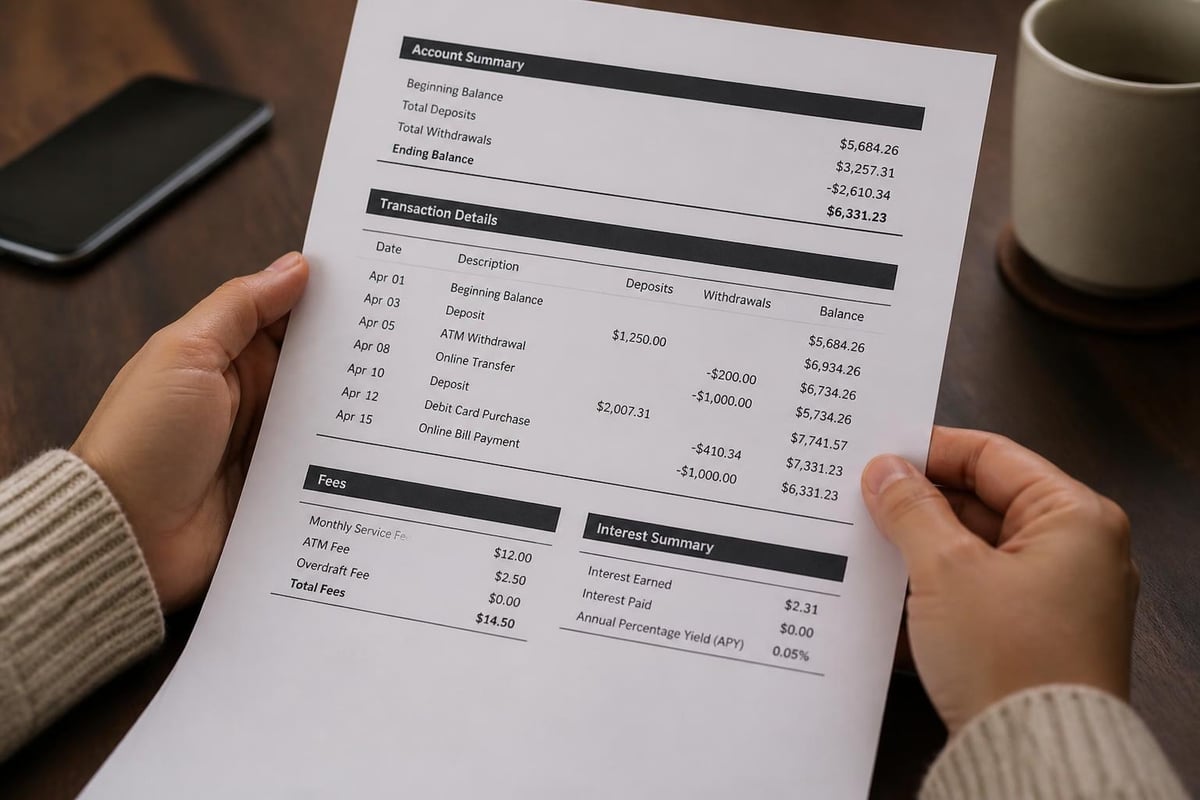
The transaction section represents the most detailed portion, listing each debit and credit with specific merchant names, check numbers, ATM withdrawals, and electronic transfers. This granular detail enables precise account reconciliation and expense tracking.
How to Access Your Bank Statement US Bank Online
US Bank provides multiple methods for accessing bank statements, with digital access becoming the preferred option for most customers in 2026. The online banking platform offers immediate access to current and historical statements without waiting for postal delivery.
To download statements through US Bank's online portal, log into your account and navigate to the statements section within your account dashboard. The platform typically retains statements for seven years, providing extensive historical access for tax purposes and financial planning.
Step-by-Step Download Process
- Log into your US Bank online banking account
- Select the account for which you need a statement
- Click on "Statements & Documents" in the account menu
- Choose the statement period from the available options
- Download the PDF file to your device
Complete instructions for downloading bank statements from various institutions can help if you encounter difficulties with the specific interface. US Bank's platform is designed for user-friendliness, but navigation can vary slightly between personal and business accounts.
Most account holders receive statements in PDF format, which preserves the official formatting and ensures compatibility across devices. However, converting these PDFs into editable spreadsheets often becomes necessary for accounting purposes, budgeting analysis, or integration with financial software.
Reading and Understanding Your US Bank Statement
Interpreting a bank statement us bank provides requires attention to specific details that reveal your financial health and account status. Each section of a bank statement serves a distinct purpose in documenting your banking activity and helping you maintain accurate records.
The statement opening typically displays your account summary with four critical numbers: the beginning balance from the previous statement, total deposits added during the period, total withdrawals or payments made, and the ending balance. These numbers should align with your personal records and provide a quick snapshot of cash flow.
Transaction Codes and Descriptions
US Bank uses standardized codes and abbreviations to categorize transactions:
| Transaction Type | Common Code | Description |
|---|---|---|
| ATM Withdrawal | ATM WD | Cash withdrawn from automated teller machine |
| Debit Card Purchase | POS | Point of sale transaction |
| Electronic Transfer | ACH | Automated clearing house payment |
| Check Payment | CK# | Check number followed by amount |
| Direct Deposit | DIR DEP | Payroll or automatic deposit |
| Wire Transfer | WIRE | Incoming or outgoing wire payment |
Understanding these codes helps categorize expenses accurately and identify transaction patterns. Some codes may include merchant names or additional reference numbers that provide context for each entry.
Reading bank statements effectively requires reviewing not just the transactions themselves but also the dates they posted versus when they occurred. The posting date determines which statement period includes the transaction, which matters significantly for month-end reconciliation.

Common Uses for US Bank Statements
A bank statement us bank customers maintain serves numerous practical purposes beyond simple record-keeping. Financial institutions, government agencies, and other organizations frequently require these documents as proof of financial stability and transaction history.
Financial Applications and Verification
Bank statements represent essential documentation when applying for loans, mortgages, or credit cards. Lenders review statements to verify income through direct deposits, assess spending patterns, and evaluate financial responsibility. Most lenders request three to six months of consecutive statements to establish patterns rather than isolated snapshots.
Tax preparation represents another critical use case. Business owners need detailed transaction records to claim deductions, track business expenses, and justify income reported on tax returns. Even individual taxpayers may need statements to verify charitable contributions, medical expenses, or other itemized deductions.
Additional applications include:
- Rental applications: Landlords verify income and financial stability
- Legal proceedings: Divorce cases, estate settlements, and financial disputes
- Immigration applications: Proof of financial resources for visa requirements
- Financial aid: College financial aid offices assess family financial situations
- Government benefits: Social Security and assistance programs verify income and assets
Understanding what bank statements show regarding transactions and fees helps you prepare appropriate documentation for each specific purpose.
Managing Multiple US Bank Accounts
Many individuals and businesses maintain several accounts with US Bank, including checking accounts, savings accounts, money market accounts, and business accounts. Each account generates a separate statement, creating challenges for comprehensive financial tracking.
Consolidating information from multiple bank statement us bank documents requires systematic organization and often technological assistance. Manual entry of transactions from several statements into spreadsheets or accounting software consumes significant time and introduces error risks.
Strategies for Multi-Account Management
| Challenge | Solution | Benefit |
|---|---|---|
| Time-consuming data entry | Automated conversion services | Reduces processing time by 90% |
| Human transcription errors | AI-powered extraction | Achieves 99% accuracy in data capture |
| Format incompatibility | Direct platform integration | Seamless import to accounting software |
| Historical data access | Centralized digital archive | Quick retrieval of past statements |
Business owners particularly benefit from streamlined processes that combine data from operating accounts, payroll accounts, and credit card statements into unified reports. This consolidated view enables better cash flow analysis and financial decision-making.
For professionals handling multiple statements regularly, converting PDF bank statements to spreadsheet format streamlines the entire workflow and ensures compatibility with accounting platforms like QuickBooks.
Security Considerations for Bank Statements
A bank statement us bank issues contains sensitive personal and financial information that requires careful protection. Account numbers, transaction details, and balance information provide everything identity thieves need to commit fraud.
Financial institutions implement robust security measures to protect statements during transmission and storage, but customers bear responsibility for securing downloaded documents. PDF statements stored on computers, tablets, or phones need protection through encryption and secure password practices.
Best Practices for Statement Security
- Password-protect PDF files when storing them on any device
- Use encrypted cloud storage rather than email for statement transmission
- Shred physical statements before disposal using cross-cut shredders
- Enable two-factor authentication for online banking access
- Regularly monitor accounts for unauthorized transactions
- Avoid public Wi-Fi when accessing or downloading statements
When sharing statements with accountants, bookkeepers, or loan officers, verify their data handling practices and confirm they maintain appropriate security standards. Third-party services processing bank statements should offer bank-level encryption and comply with financial data protection regulations.

Business owners face additional considerations when multiple employees need access to financial statements. Establishing clear protocols about who can access statements, how they're stored, and when they're deleted helps prevent data breaches.
Converting Bank Statements for Accounting Use
Processing a bank statement us bank provides for accounting purposes traditionally involved manual data entry into spreadsheets or accounting software. This time-intensive process creates bottlenecks in financial workflows and introduces opportunities for transcription errors that complicate reconciliation.
Modern approaches leverage technology to extract data from PDF statements automatically. Questions about banking operations often center on finding efficient methods to integrate statement data with existing financial systems without sacrificing accuracy.
The conversion process transforms static PDF documents into editable formats compatible with accounting platforms. This transformation enables automatic categorization, trend analysis, and financial reporting that would be impractical with manual processing.
Benefits of Automated Statement Processing
Businesses handling numerous transactions monthly find automated conversion particularly valuable. A single business checking account might record hundreds of transactions each month, making manual entry prohibitively time-consuming.
Key advantages include:
- Time savings: Converting statements in minutes rather than hours
- Accuracy improvement: Eliminating manual transcription errors
- Consistent formatting: Standardized data structure across all statements
- Easy reconciliation: Direct comparison with accounting records
- Historical analysis: Quick trend identification across multiple periods
Professional service providers and small businesses benefit from converting checking statements into formats that integrate seamlessly with their existing financial management systems. This integration supports better decision-making through real-time financial visibility.
Statement Reconciliation Best Practices
Reconciling a bank statement us bank sends each month represents a fundamental accounting practice that catches errors, identifies fraud, and maintains accurate financial records. The reconciliation process compares your internal records against the bank's official statement to ensure agreement.
Discrepancies between your records and the bank statement can arise from several sources: outstanding checks that haven't cleared, deposits in transit, bank fees you hadn't recorded, or calculation errors in your books. Systematic reconciliation identifies these differences and determines appropriate adjustments.
Monthly Reconciliation Workflow
The reconciliation process follows a logical sequence that ensures thorough review:
- Gather your internal records and the bank statement for the period
- Compare the ending balance on the statement with your register
- Mark off each transaction that appears in both records
- Identify outstanding checks and deposits in transit
- Note any bank fees or interest not yet recorded
- Calculate the adjusted balance and investigate any remaining differences
- Make necessary corrections to your internal records
Professional accountants often work with statements spanning multiple months, particularly when preparing quarterly or annual reports. Having access to 3-month bank statement PDF files facilitates comprehensive period analysis and trend identification.
Understanding Statement Formats and Layouts
The specific format of a bank statement us bank generates follows industry standards while incorporating institution-specific design elements. Understanding these bank statement formats helps you quickly locate needed information regardless of which account type you hold.
US Bank's personal checking account statements differ slightly from business account statements in terms of detail level and organizational structure. Business statements often include additional sections for merchant services, wire transfer details, and reconciliation worksheets designed for accounting departments.
Format Variations Across Account Types
| Account Type | Unique Features | Statement Focus |
|---|---|---|
| Personal Checking | Simplified categories | Daily transaction tracking |
| Business Checking | Detailed merchant codes | Revenue and expense separation |
| Savings Account | Interest calculations | Growth and transfer history |
| Money Market | Tiered interest rates | Balance optimization |
| Credit Card | APR and payment details | Credit utilization management |
Different statement formats require different processing approaches when converting to spreadsheets. Understanding these variations ensures you select appropriate conversion settings that preserve relevant data relationships.
Proper formatting for bank details becomes critical when statements feed into accounting systems that expect specific column headers, date formats, or transaction categorization schemes.
Addressing Common Statement Issues
Problems occasionally arise with a bank statement us bank issues, ranging from missing transactions to incorrect balances. Addressing these issues promptly prevents complications in accounting records and ensures accurate financial reporting.
Missing statements represent a common concern, particularly during address changes or when switching from paper to electronic delivery. US Bank maintains digital archives accessible through online banking, providing backup access when statements don't arrive as expected.
Resolving Statement Discrepancies
When you identify errors on your statement, document the specific issue with transaction dates, amounts, and descriptions before contacting the bank. Understanding what bank statements contain helps you communicate problems effectively with customer service representatives.
Common issues and solutions include:
- Duplicate transactions: Verify with merchant before disputing; some charges post twice temporarily
- Incorrect amounts: Compare receipts with statement entries; report within 60 days
- Unauthorized charges: Report immediately for fraud investigation
- Missing deposits: Check deposit dates versus posting dates; confirm with sender
- Unexpected fees: Review fee schedule; contact bank for fee explanations or reversals
US Bank provides specific timeframes for disputing transactions, typically 60 days for most errors and shorter windows for debit card fraud. Acting quickly protects your rights under federal banking regulations.
Leveraging Statements for Financial Planning
Beyond compliance and reconciliation, a bank statement us bank provides offers valuable insights for financial planning and budgeting. Analyzing spending patterns revealed in monthly statements helps identify opportunities for savings and financial optimization.
Transaction history shows exactly where money goes each month, often revealing surprising patterns in discretionary spending. Categorizing transactions by type (groceries, entertainment, utilities, transportation) creates a realistic foundation for budget development.
Statement Analysis Techniques
Effective financial planning requires looking beyond individual transactions to broader patterns:
- Calculate category totals: Sum all transactions within each spending category
- Compare month-over-month: Identify trends and seasonal variations
- Track recurring charges: Ensure subscriptions still provide value
- Monitor balance patterns: Understand cash flow timing issues
- Identify optimization opportunities: Find areas for potential savings
Converting statements to spreadsheet format enables this analytical work through sorting, filtering, and pivot tables that reveal insights buried in transaction lists. Converting bank statements to Excel format provides the flexibility needed for comprehensive financial analysis.
Business owners use statement analysis to understand customer payment patterns, identify seasonal revenue fluctuations, and optimize working capital management. This strategic use of statement data supports informed decision-making beyond basic bookkeeping.
Digital Banking and Statement Access Trends
The evolution of digital banking continues transforming how customers access and utilize a bank statement us bank provides. Mobile banking apps now offer instant access to transaction history and statement downloads from smartphones, eliminating the need for desktop computers or branch visits.
Real-time transaction alerts supplement monthly statements by providing immediate notification of account activity. These alerts help customers identify unauthorized transactions within hours rather than weeks, significantly reducing fraud exposure.
Emerging Statement Technologies
Banking technology in 2026 incorporates advanced features that enhance statement utility:
- AI-powered categorization: Automatic expense categorization based on merchant data
- Integrated budgeting tools: Compare actual spending against budgeted amounts
- Visual spending reports: Graphs and charts showing expenditure patterns
- Predictive cash flow: Forecasting based on historical transaction patterns
- Cross-institution aggregation: Consolidated view of accounts from multiple banks
Despite these technological advances, the core bank statement remains the authoritative record for most financial purposes. Third-party applications provide convenience, but official statements from the institution carry legal weight for verification purposes.
Understanding the importance of accurate banking information helps account holders balance convenience with the need for official documentation in formal situations.
Managing financial records efficiently requires understanding how to access, read, and utilize bank statements effectively. Whether you're reconciling accounts monthly, preparing tax returns, or analyzing spending patterns, US Bank statements provide the authoritative documentation necessary for sound financial management. Bank Statement Boss helps streamline your financial workflow by converting PDF bank statements into spreadsheet format with 99% accuracy, enabling seamless integration with your accounting systems while maintaining bank-level security for your sensitive financial data.