
Financial institutions and their customers face unprecedented challenges in protecting sensitive banking information. Bank statement security bank protocols have evolved significantly as cyber threats become more sophisticated and data breaches more costly. Understanding how to safeguard bank statements-whether in digital or physical form-is critical for businesses, accountants, and individuals who handle financial records regularly. This comprehensive guide explores the essential security measures, best practices, and modern solutions that protect bank statements from unauthorized access and fraudulent activity.
Understanding Bank Statement Security Risks
Bank statements contain a wealth of personal and financial information that makes them prime targets for identity thieves and fraudsters. Account numbers, routing information, transaction histories, and balance details provide everything a criminal needs to compromise financial accounts or steal identities.
Common Threats to Bank Statement Data
Modern criminals employ multiple tactics to access bank statement information. Phishing emails that appear to come from legitimate financial institutions trick users into revealing login credentials or downloading malware. Social engineering attacks manipulate individuals into sharing sensitive information through seemingly trustworthy requests. Social engineering fraud has become increasingly sophisticated, requiring businesses to implement layered defense strategies.
Physical theft remains a concern despite the digital age. Stolen mail, discarded documents without proper shredding, and unauthorized access to filing systems all present vulnerabilities. Even digital storage faces risks from:
- Unencrypted file storage on personal devices
- Weak password protection on financial accounts
- Unsecured email transmission of statement files
- Compromised cloud storage accounts
- Malware that captures screenshots or keystrokes

The Growing Sophistication of Statement Fraud
Criminals have developed advanced techniques to create convincing fake bank statements for loan applications, rental agreements, and other verification purposes. Identifying fraudulent bank statements requires careful attention to formatting inconsistencies, mathematical errors, and unusual transaction patterns. Financial professionals must verify statement authenticity through direct bank confirmation rather than relying solely on visual inspection.
Essential Bank Statement Security Bank Practices
Implementing robust security measures protects both individuals and organizations from the consequences of compromised bank statement security bank data. These practices form the foundation of a comprehensive protection strategy.
Digital Security Fundamentals
Encryption serves as the first line of defense for digital bank statements. All statement files should be encrypted both in transit and at rest, ensuring that intercepted data remains unreadable without proper decryption keys. Modern encryption standards like AES-256 provide military-grade protection for sensitive financial documents.
Password management extends beyond simple complexity requirements. Financial accounts and any systems storing bank statements require:
- Unique passwords for each financial institution and storage location
- Multi-factor authentication adding an extra verification layer
- Regular password updates every 90 days at minimum
- Password manager tools to generate and securely store complex credentials
Access controls limit who can view or modify bank statement data within an organization. Role-based permissions ensure employees only access the financial information necessary for their job functions. Audit trails track every instance of statement access, creating accountability and enabling rapid detection of unauthorized viewing.
| Security Measure | Implementation | Frequency |
|---|---|---|
| Password Changes | Update all financial account passwords | Every 90 days |
| Access Review | Audit user permissions and remove unnecessary access | Monthly |
| Security Training | Employee education on phishing and fraud detection | Quarterly |
| System Updates | Apply security patches to all software handling statements | As released |
Physical Document Protection
Paper bank statements require equally stringent security protocols. Secure storage in locked filing cabinets or safes prevents unauthorized physical access. Understanding how long banks keep statements by law helps determine appropriate retention periods before secure disposal.
Document destruction must be thorough and complete. Cross-cut shredders render statements unreadable, while professional document destruction services provide certified disposal for businesses with high volumes of financial records. Never dispose of intact bank statements in regular trash or recycling bins.
Securing Bank Statement Transmission and Sharing
Sharing bank statements with accountants, lenders, or other authorized parties introduces additional security considerations. The method of transmission significantly impacts bank statement security bank integrity.
Safe Sharing Protocols
Email remains one of the least secure methods for transmitting bank statements, yet it remains common practice. When email transmission is unavoidable, always use encrypted email services or password-protected ZIP files. Send the password through a separate communication channel to prevent a single intercepted message from compromising the statement.
Secure file-sharing platforms offer superior protection for bank statement transmission. These services provide:
- End-to-end encryption during file transfer
- Password protection with expiration dates
- Download tracking and access logs
- Automatic deletion after specified timeframes
- Multi-factor authentication for recipients
Understanding what information to redact when sharing bank statements protects privacy while meeting verification requirements. Account numbers can be partially masked, leaving only the last four digits visible. Personal transactions unrelated to the verification purpose should be redacted entirely.

Converting Statements Safely
Many businesses need to convert PDF bank statements to spreadsheet format for accounting purposes. This conversion process introduces potential security vulnerabilities if not handled properly. Services offering bank statement conversion must maintain the same security standards as financial institutions themselves, including encryption, secure data handling, and automatic deletion of source documents after processing.
When evaluating conversion services, verify they provide:
- Bank-level encryption for all data transmission and storage
- Zero data retention policies that delete files immediately after conversion
- SOC 2 compliance or equivalent security certifications
- Privacy policies explicitly protecting financial data
- Secure API connections for platform integrations
Implementing Organizational Bank Statement Security
Businesses handling multiple bank statements face amplified security risks. Comprehensive organizational policies create consistent protection across all financial documents and personnel.
Developing Security Policies
Written security policies establish clear expectations and procedures for handling bank statement security bank data. These documents should address access authorization, acceptable use, storage requirements, transmission protocols, and incident response procedures. Regular policy reviews ensure guidelines remain current with evolving threats and technologies.
Employee training transforms security policies from theoretical documents into practical safeguards. Personnel at all levels must understand:
- How to identify phishing attempts and suspicious requests
- Proper procedures for accessing and storing bank statements
- Recognition of social engineering tactics
- Immediate reporting protocols for suspected breaches
- Their individual responsibility in maintaining security
Monitoring and Incident Response
Regular bank statement reviews serve as a top fraud-fighting tool, enabling early detection of unauthorized transactions or account access. Organizations should implement systematic review schedules with defined responsibility assignments and escalation procedures for discrepancies.
Incident response plans prepare organizations to act swiftly when security breaches occur. These plans outline:
- Immediate containment steps to prevent further exposure
- Notification procedures for affected parties and authorities
- Forensic investigation to determine breach scope and method
- Remediation measures to close security gaps
- Communication strategies for stakeholders and customers
Technology Solutions for Enhanced Security
Modern technology provides powerful tools for strengthening bank statement security bank protocols beyond basic encryption and access controls.
Advanced Authentication Methods
Biometric authentication adds a layer of security that cannot be easily replicated or stolen. Fingerprint scanning, facial recognition, and voice verification provide stronger identity confirmation than passwords alone. When combined with traditional authentication factors, biometric methods create nearly impenetrable security.
Behavioral analytics monitor how users typically interact with financial systems, flagging unusual patterns that might indicate compromised credentials. If an account suddenly accesses bank statements from a new geographic location or at unusual times, the system can require additional verification or temporarily restrict access.
Automated Security Monitoring
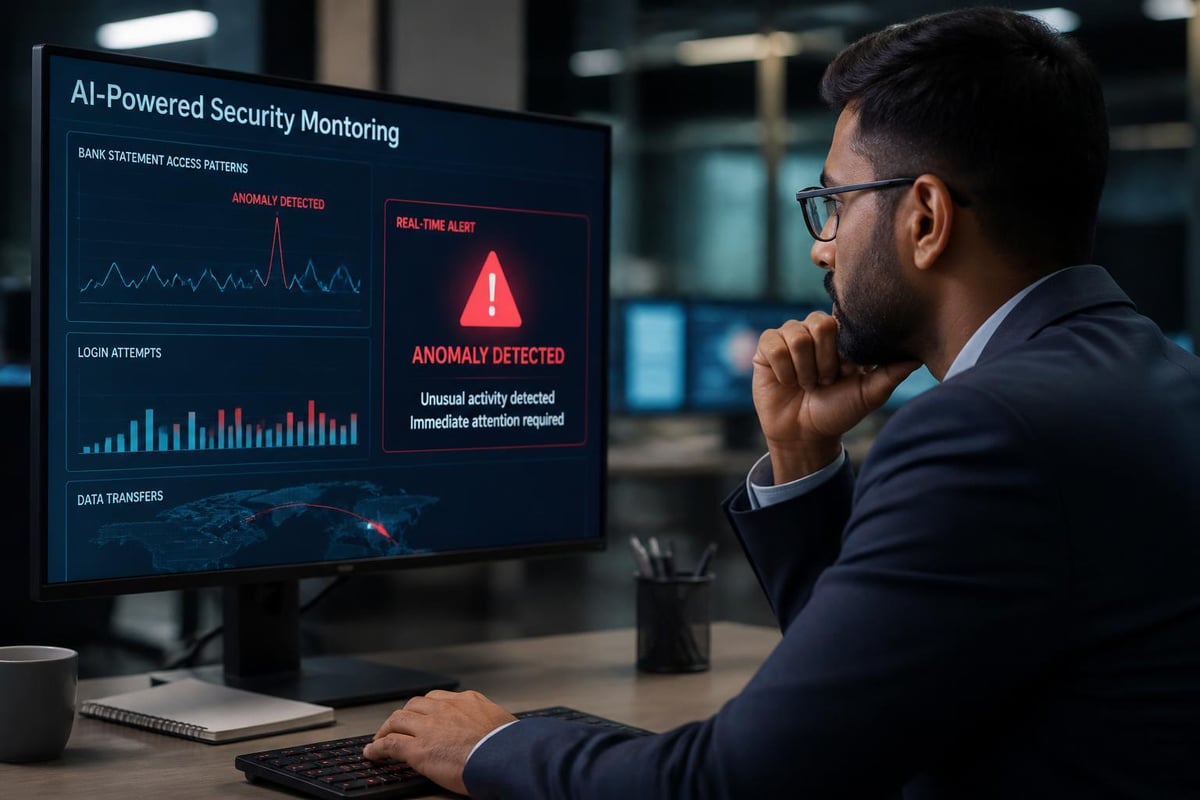
Artificial intelligence and machine learning algorithms continuously scan for security threats and anomalies. These systems detect patterns that human reviewers might miss, including:
- Unusual data access patterns suggesting insider threats
- Failed login attempts indicating brute force attacks
- Abnormal file transfers or downloads
- Suspicious network traffic to financial systems
- Malware signatures in uploaded or downloaded files
Real-time alerts enable immediate response to potential security incidents before significant damage occurs. Automated blocking can prevent suspected unauthorized access while security teams investigate.
Compliance and Regulatory Considerations
Financial data protection is not merely a best practice-numerous regulations mandate specific security measures for organizations handling bank statements and other sensitive financial information.
Understanding Regulatory Requirements
The Gramm-Leach-Bliley Act (GLBA) requires financial institutions and their service providers to protect customer information through administrative, technical, and physical safeguards. Organizations processing bank statements must implement security programs addressing each of these categories.
State-level data breach notification laws require organizations to inform affected individuals when security incidents expose personal information. These laws vary by jurisdiction but generally mandate notification within specific timeframes, creating urgency for rapid incident detection and response.
| Regulation | Scope | Key Requirements |
|---|---|---|
| GLBA | Financial institutions and service providers | Administrative, technical, and physical safeguards for customer data |
| SOX | Public companies and their service providers | Internal controls and audit trails for financial reporting |
| State Data Breach Laws | Organizations handling personal information | Notification within specific timeframes after security incidents |
| PCI DSS | Organizations processing payment cards | Secure network, access controls, regular monitoring and testing |
Maintaining Compliance Documentation
Demonstrating compliance requires thorough documentation of security policies, procedures, and implementation. Organizations should maintain records of:
- Security policy versions and approval dates
- Employee training completion and assessment results
- Access control configurations and permission changes
- Security incident reports and response actions
- Third-party vendor security assessments
- Penetration testing and vulnerability scan results
Regular audits verify that documented policies match actual practices. Internal audits identify gaps before external auditors or regulators discover them, providing opportunities for proactive remediation.
Future Trends in Bank Statement Security
The landscape of bank statement security bank protection continues evolving as technology advances and threats become more sophisticated. Understanding emerging trends helps organizations prepare for future security challenges.
Blockchain and Distributed Ledger Technology
Blockchain technology offers potential for creating tamper-proof records of bank statements and transactions. The distributed nature of blockchain makes unauthorized alterations virtually impossible, as changes would need to occur across multiple nodes simultaneously. While widespread adoption in banking remains limited, pilot programs demonstrate promising applications for secure document verification.
Zero-Trust Architecture
Traditional security models assume users within an organization's network are trustworthy, creating vulnerabilities when credentials are compromised. Zero-trust architecture treats every access request as potentially hostile, requiring continuous verification regardless of network location or previous authentication. This approach significantly reduces the risk of unauthorized bank statement access from compromised internal accounts.
Advanced verification technologies will make it increasingly difficult to create convincing fake bank statements. Digital signatures embedded in official statements, blockchain-based verification systems, and AI-powered authenticity detection will help recipients confirm document legitimacy instantly.
Enhanced Privacy Technologies
Homomorphic encryption allows computations on encrypted data without decryption, enabling bank statement analysis and processing while maintaining complete data privacy. Organizations could verify income, calculate averages, or perform other necessary functions on encrypted statements without ever viewing the underlying sensitive information.
Selecting Secure Bank Statement Processing Services
Many businesses require external services for bank statement processing, whether for conversion, analysis, or verification purposes. Choosing providers with robust bank statement security bank measures is essential for maintaining data protection.
Security Criteria for Service Evaluation
Third-party service providers should demonstrate security capabilities meeting or exceeding banking industry standards. Request detailed information about:
- Data encryption methods for transmission and storage
- Data retention policies including automatic deletion timeframes
- Access controls limiting which personnel can view customer data
- Security certifications such as SOC 2, ISO 27001, or similar standards
- Insurance coverage for data breaches and security incidents
- Incident response capabilities and notification procedures
Comprehensive security information should be readily available and transparent, not hidden behind vague marketing language. Providers committed to security make their practices clear and welcome detailed security discussions.
Integration Security Considerations
Services that integrate with accounting platforms or other business systems introduce additional security considerations. API connections must use secure authentication methods, encrypted data transmission, and minimal permission scopes. Regular security reviews of integrated systems ensure that updates or configuration changes haven't introduced new vulnerabilities.
Verify that service providers maintain security certifications and undergo regular third-party security audits. Current security documentation and compliance status should be easily verifiable and updated regularly to reflect ongoing security investments.
Best Practices for Different User Types
Bank statement security bank requirements vary depending on the user's role and the volume of statements handled. Tailored approaches address specific needs while maintaining comprehensive protection.
Individual Account Holders
Personal bank statement security focuses on protecting statements from the moment they arrive until proper disposal. Opt for paperless statements delivered through secure banking portals rather than physical mail, reducing interception risks. When accessing online banking, always:
- Use secure, private networks rather than public Wi-Fi
- Verify website authenticity before entering credentials
- Log out completely after viewing statements
- Enable account alerts for all transactions
- Review statements promptly after they become available
Understanding typical checking statement patterns helps identify unauthorized transactions quickly. Unusual merchants, unfamiliar transaction amounts, or unexpected account activity warrant immediate investigation and bank notification.
Small Business Owners
Small businesses typically handle multiple bank accounts and larger transaction volumes, requiring more structured security approaches. Designate specific personnel for financial record management and restrict access to bank statements based on job responsibilities. Implement separation of duties so that no single person controls all aspects of financial record handling.
Requesting statements systematically ensures complete records for accounting and tax purposes while maintaining security throughout the retrieval process. Maintain organized digital filing systems with encryption and regular backups to secure locations.
Accounting Professionals
Accountants and bookkeepers handle bank statements for multiple clients, creating amplified security responsibilities. Professional liability extends to maintaining client confidentiality and data security. Implement these specialized practices:
- Client-specific access controls preventing cross-contamination of financial data
- Secure client portals for statement upload and download
- Professional liability insurance covering data breaches and security incidents
- Written security policies provided to all clients
- Regular security training for all staff handling financial documents
Converting PDF statements efficiently while maintaining security requires services specifically designed for professional use, with audit trails, secure processing, and guaranteed data deletion.
Responding to Bank Statement Security Breaches
Despite best prevention efforts, security incidents may still occur. Rapid, effective response minimizes damage and helps restore security.
Immediate Response Actions
Upon discovering a potential bank statement security breach, take immediate action to contain the incident. Change all passwords for affected accounts and any accounts using the same credentials. Contact financial institutions immediately to report the breach and request enhanced monitoring. Implementing fraud prevention measures provided by banks adds extra layers of protection during the vulnerable period following a breach.
Document everything related to the incident, including when the breach was discovered, what information was potentially exposed, and all actions taken in response. This documentation proves valuable for insurance claims, regulatory reporting, and forensic investigation.
Long-Term Recovery and Prevention
After addressing the immediate crisis, conduct a thorough analysis of how the breach occurred and what security gaps enabled it. Implement corrective measures addressing the root cause, not just the symptoms. Update security policies and training programs to prevent similar incidents.
Consider engaging cybersecurity professionals for penetration testing and vulnerability assessments. External experts often identify security weaknesses that internal teams overlook due to familiarity with existing systems.
Monitor credit reports and account activity closely for months after a breach, as criminals may delay using stolen information to avoid immediate detection. Services offering credit monitoring and identity theft protection provide ongoing vigilance during the extended vulnerability period.
Protecting bank statement security bank data requires comprehensive strategies combining technology, policies, and vigilance. The financial information contained in bank statements demands the highest level of protection against evolving threats in 2026. Whether you're an individual safeguarding personal finances, a business protecting company records, or an accounting professional managing client data, implementing robust security measures is non-negotiable. Bank Statement Boss understands these critical security requirements and provides bank-level encryption and data protection for all statement conversions, ensuring your sensitive financial information remains secure throughout the entire processing workflow.