
Understanding financial documentation is fundamental to maintaining accurate business records and making informed decisions. A bank statement sample serves as a valuable reference tool for business owners, accountants, and financial professionals who need to familiarize themselves with the structure and content of these essential documents. Whether you're onboarding new staff, implementing accounting procedures, or simply want to improve your financial literacy, examining a comprehensive bank statement sample provides clarity on what information these statements contain and how to interpret them effectively.
What Information Does a Bank Statement Sample Include
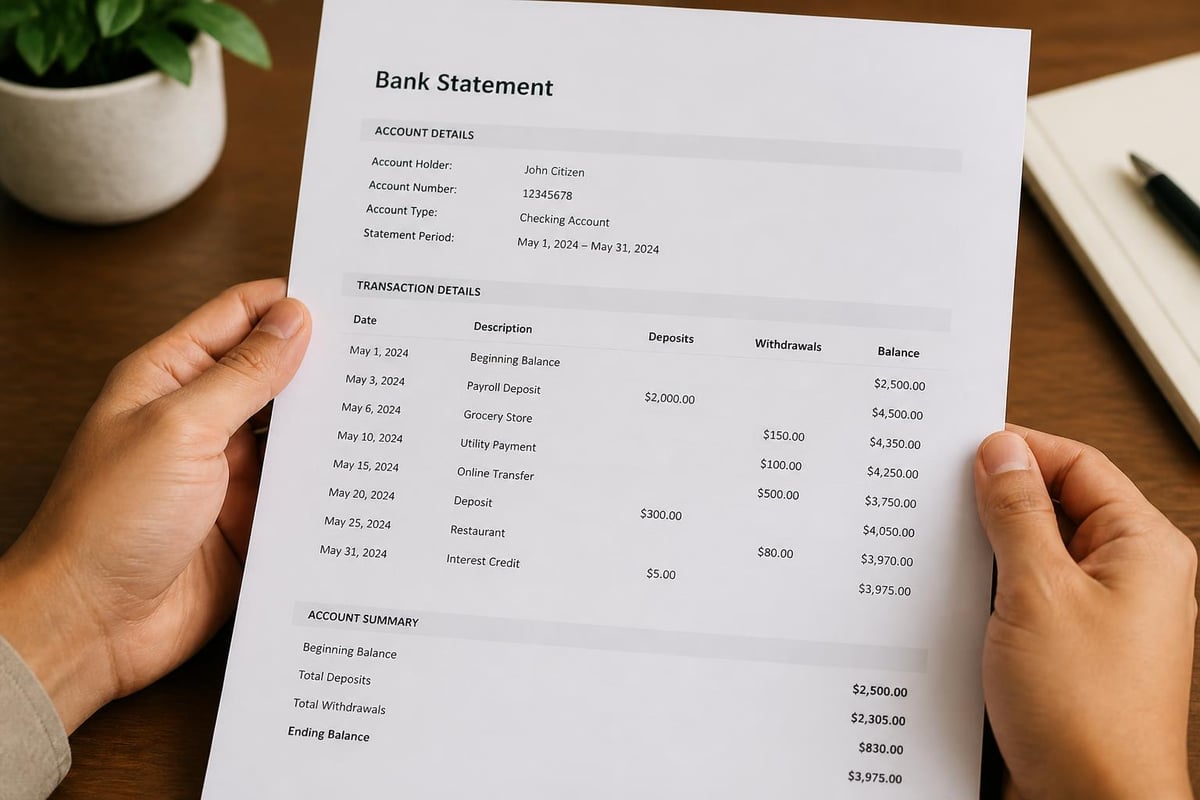
Every bank statement sample follows a standardized format designed to provide a complete overview of account activity during a specific period. The header section typically contains your account information, including the account holder name, account number, statement period dates, and the financial institution's contact details. This section also displays the statement generation date and page numbers for multi-page statements.
Key components found in most bank statement samples include:
- Account summary with beginning and ending balances
- Detailed transaction history with dates and descriptions
- Deposit and credit entries
- Withdrawal and debit entries
- Fee assessments and interest earned
- Daily balance information
The transaction section represents the core of any bank statement sample, listing every financial activity in chronological order. Each entry shows the transaction date, a description of the activity, and the amount debited or credited to the account. Understanding how bank statements present this information helps businesses track cash flow patterns and identify discrepancies quickly.
Reading Transaction Descriptions Accurately
Transaction descriptions in a bank statement sample can vary significantly depending on the merchant, payment method, and transaction type. Electronic payments often include reference numbers, check transactions display check numbers, and card purchases show merchant names with location codes. Deciphering these descriptions requires attention to detail, as abbreviated merchant names or generic descriptors can make reconciliation challenging.
Many businesses struggle with transaction identification when descriptions don't match their internal records. Wire transfers typically include sender or recipient information, while automated clearing house (ACH) transactions display the originating company name. Learning to interpret these variations through examining multiple bank statement samples improves accuracy during the reconciliation process.
Different Bank Statement Sample Formats
Financial institutions provide statements in various formats, each serving different purposes and offering distinct advantages for data management. The most common format is PDF, which preserves the original statement layout and provides a secure, unalterable record. However, businesses that need to analyze transaction data or import information into accounting software often require more flexible formats.
| Format Type | Best Use Case | Data Manipulation | Import Capability |
|---|---|---|---|
| Archive and verification | Limited | Requires conversion | |
| CSV | Spreadsheet analysis | Excellent | High compatibility |
| OFX | Accounting software | Good | Direct import |
| QFX | QuickBooks specific | Good | Native QuickBooks |
Understanding different bank statement formats helps businesses choose the right option for their workflow. While PDF versions provide comprehensive visual representations ideal for reviewing statement samples, spreadsheet formats enable sorting, filtering, and mathematical operations that facilitate financial analysis. Many accounting professionals maintain both PDF archives and converted spreadsheet versions to leverage the benefits of each format.
Converting PDF Bank Statement Samples to Spreadsheets
The challenge with PDF bank statement samples lies in extracting usable data for accounting purposes. Manual data entry from PDF statements into spreadsheets consumes significant time and introduces opportunities for human error. Modern businesses increasingly rely on automated solutions that can convert PDF bank statements to usable spreadsheets with high accuracy, preserving transaction details while organizing them in formats compatible with popular accounting platforms.
Conversion accuracy matters tremendously when dealing with financial data. A single transposition error or missed transaction can create reconciliation headaches and compromise financial reporting accuracy. Advanced conversion technologies use pattern recognition and data validation to ensure that amounts, dates, and descriptions transfer correctly from the original bank statement sample to the spreadsheet format.
Essential Elements in Business Bank Statement Samples
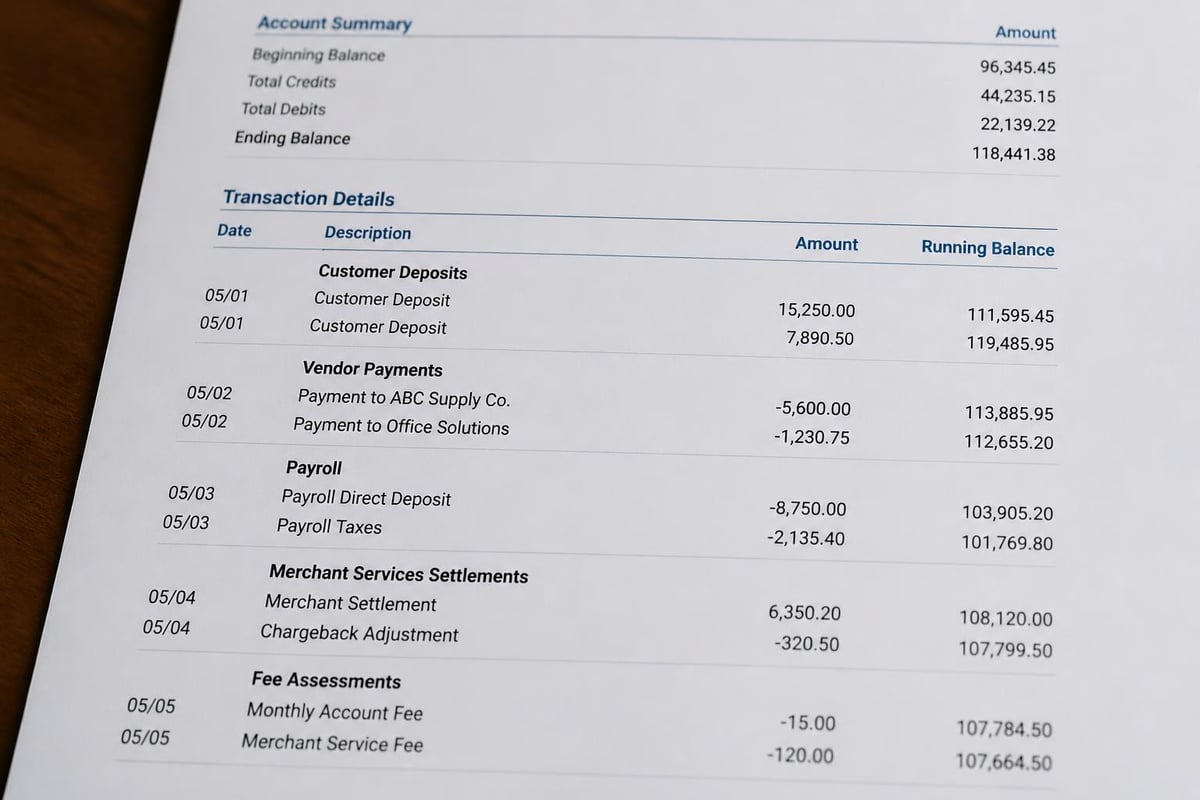
Business bank statement samples differ from personal statements in several important ways. Commercial accounts typically show higher transaction volumes, include merchant services deposits, display payroll processing activities, and may feature loan payment information. The complexity of business banking relationships means that statement samples often span multiple pages and contain various subsections for different account features.
Transaction Volume and Categorization
Business bank statement samples frequently contain hundreds or thousands of transactions per month, making manual review impractical without proper organization. Examining a representative sample helps businesses understand how their bank groups similar transactions and whether the default categorization aligns with internal accounting needs.
Common business transaction categories include:
- Customer payments and deposits
- Vendor payments and checks
- Payroll processing fees
- Credit card merchant settlements
- Tax payments and government fees
- Loan payments and interest charges
- Bank service charges
The way transactions appear in a bank statement sample directly impacts reconciliation efficiency. When businesses understand their statement structure through careful sample analysis, they can develop streamlined processes for matching transactions to internal records and identifying exceptions requiring investigation.
How to Use Bank Statement Samples for Training
Bank statement samples serve as invaluable training tools for new accounting staff, bookkeepers, and financial managers. Rather than working with live client data during the learning phase, trainees can study representative samples to understand statement layouts, practice reconciliation techniques, and learn to spot common issues without risking actual financial data integrity.
Creating a library of anonymized bank statement samples from various institutions helps team members become familiar with different formats and naming conventions. Each bank presents information slightly differently, and exposure to multiple statement styles builds versatility. Training programs should include samples showing both routine transactions and problematic scenarios like duplicate charges, reversed transactions, and fee assessments that require special handling.
Identifying Red Flags and Anomalies
Experienced financial professionals develop an instinct for spotting unusual activity in bank statements. By studying bank statement samples that highlight common issues, team members learn to recognize patterns that warrant investigation. Duplicate transactions, unexpected fee increases, unauthorized charges, and mathematical discrepancies become easier to identify after reviewing multiple annotated samples.
The educational value of a comprehensive bank statement sample extends beyond basic reading skills. Understanding how to verify mathematical accuracy, cross-reference deposit amounts against receivables records, and confirm that cleared checks match issued amounts requires hands-on practice with realistic examples. Reading bank statements effectively involves developing these analytical skills through repeated exposure and guided learning.
Bank Statement Sample Analysis for Financial Planning
Beyond daily bookkeeping, bank statement samples provide crucial data for financial planning and business strategy. Analyzing patterns in a bank statement sample reveals spending trends, seasonal variations in cash flow, and opportunities for cost reduction. The transaction history section contains valuable intelligence about vendor relationships, payment timing, and cash management efficiency.
Business owners who regularly review bank statement samples gain insights into their company's financial health that might not be apparent from summary reports alone. The granular transaction detail shows exactly where money flows in and out of the business, which vendors receive the most payments, and how banking fees accumulate over time.
Cash Flow Pattern Recognition
A series of bank statement samples spanning several months or years enables sophisticated cash flow analysis. By examining beginning and ending balances across multiple periods, businesses can identify their natural cash flow cycles and plan accordingly. Seasonal businesses particularly benefit from this historical perspective, as past statement samples guide predictions about future capital needs.
| Analysis Type | What Statement Samples Reveal | Business Benefit |
|---|---|---|
| Deposit Patterns | Revenue timing and consistency | Cash flow forecasting |
| Payment Timing | Vendor payment schedules | Working capital optimization |
| Fee Analysis | Monthly banking costs | Cost reduction opportunities |
| Balance Trends | Account balance fluctuations | Minimum balance compliance |
Understanding how to interpret bank statements for financial insights transforms these documents from simple record-keeping tools into strategic planning resources. The patterns revealed in statement samples inform decisions about credit line needs, investment timing, and operational budgeting.

Reconciliation Best Practices Using Statement Samples
Reconciliation represents one of the most critical accounting processes, and bank statement samples provide the foundation for this activity. The reconciliation process involves comparing the bank's record of transactions against the company's internal records to ensure agreement and identify discrepancies. Regular reconciliation prevents fraud, catches errors, and maintains accurate financial records.
Starting with a clear bank statement sample, accountants systematically verify that each transaction appears in both the bank record and the company's books. Outstanding checks, deposits in transit, and bank fees require special attention during this process. The statement sample serves as the authoritative source for what the bank actually processed, while the company's records reflect what transactions were initiated.
Common Reconciliation Challenges
Even with a clear bank statement sample, reconciliation can present difficulties. Timing differences between when a company records a transaction and when the bank processes it create temporary discrepancies. Checks written near month-end may not clear until the following period, and electronic transfers may process on different dates than expected.
Frequent reconciliation obstacles include:
- Transaction description mismatches between bank and internal records
- Duplicate transaction entries in accounting software
- Unrecorded bank fees or interest
- Mathematical errors in manual ledger entries
- Lost or missing transaction documentation
Developing reconciliation expertise requires practice with diverse bank statement samples representing different scenarios. Trainees benefit from working through reconciliation exercises using samples with intentional discrepancies, learning to systematically identify and resolve each type of issue. The various formats that bank statements come in can also affect reconciliation workflows, making format familiarity essential.
Security Considerations for Bank Statement Samples
Bank statements contain highly sensitive financial information that requires careful handling and protection. Even when using samples for training or demonstration purposes, best practices demand removing or anonymizing personal details like account numbers, addresses, and specific transaction parties. The confidential nature of banking information means that actual statements should never be shared outside authorized personnel.
When creating bank statement samples for educational use, organizations must implement thorough redaction procedures. Simply blacking out account numbers may prove insufficient if other identifying information remains visible. Comprehensive anonymization includes altering amounts, changing transaction descriptions, and modifying dates while maintaining realistic patterns and statement structure.
Data Protection Standards
Businesses handling actual bank statements must implement robust security measures consistent with financial industry standards. Digital statements require encrypted storage, access controls, and secure transmission methods. Physical statement copies need secure storage with restricted access and proper disposal procedures when retention periods expire.
The security infrastructure at Bank Statement Boss demonstrates the level of protection necessary when processing financial documents. Bank-level encryption, secure data handling protocols, and compliance with industry regulations ensure that sensitive information remains protected throughout the conversion and processing workflow.
Organizations should establish clear policies about who can access bank statements, how long they're retained, and what constitutes authorized use. Regular security training reinforces the importance of protecting financial data and helps prevent inadvertent disclosures. Understanding how to properly request and handle statements ensures compliance with both internal policies and regulatory requirements.
Leveraging Technology for Statement Processing
Modern accounting workflows increasingly rely on technology to handle the volume and complexity of financial data processing. Bank statement samples that once required manual data entry and hours of reconciliation work can now be processed automatically with advanced software solutions. This technological evolution enables businesses to redirect staff time from routine data entry to higher-value analytical work.
The transition from manual to automated statement processing begins with understanding what information needs extraction from bank statement samples. Account balances, transaction dates, descriptions, and amounts represent the core data points required for accounting systems. Additional details like check numbers, reference codes, and merchant information provide valuable context for categorization and analysis.
Accuracy in automated processing proves critical for financial data. While manual entry might achieve 95-98% accuracy on a good day, AI-powered conversion technologies can reach 99% accuracy by recognizing patterns, validating data consistency, and applying error-checking algorithms. This improvement eliminates most reconciliation discrepancies caused by transcription errors and significantly reduces the time required to close monthly books.
Integration with Accounting Platforms
The true value of converted bank statement data emerges when it integrates seamlessly with accounting platforms. Rather than recreating transaction entries manually, businesses can import formatted data directly into systems like QuickBooks, Xero, or other popular accounting software. This direct integration eliminates duplicate data entry and ensures consistency between bank records and accounting ledgers.
Different accounting platforms accept specific file formats for import, which is why understanding bank statement format options matters for workflow optimization. Some systems prefer CSV files with specific column arrangements, while others work best with dedicated financial formats like OFX or QFX. Choosing the right conversion output format streamlines the import process and reduces formatting adjustments.
The efficiency gains from automated statement processing compound over time. What might save two hours monthly for a small business translates to substantial time savings annually. For accounting firms processing statements for dozens or hundreds of clients, automation becomes not just convenient but essential for maintaining competitive pricing and service quality.
Industry-Specific Statement Variations
Bank statement samples vary not only by financial institution but also by industry and account type. Retail businesses see high volumes of small transactions from customer purchases, while manufacturing companies show larger, less frequent payments to suppliers. Understanding these industry patterns helps businesses benchmark their own statements against typical samples from similar operations.
Professional services firms often display regular client payment deposits with predictable amounts, while construction companies experience more irregular cash flow with project-based payments. Restaurant bank statement samples typically show daily merchant services deposits, frequent small vendor payments, and regular payroll processing. Each industry develops characteristic patterns visible in representative statement samples.
Industry-specific considerations include:
- Healthcare providers dealing with insurance reimbursements and patient payments
- E-commerce businesses showing multiple daily merchant settlements
- Real estate firms handling large, infrequent transaction amounts
- Subscription-based services with predictable recurring revenue patterns
- Seasonal businesses experiencing dramatic balance fluctuations
Examining bank statement samples from similar businesses provides context for evaluating financial health and operational efficiency. A restaurant owner reviewing statement samples from comparable establishments can identify whether their vendor payment frequency, banking fees, or deposit patterns align with industry norms. This benchmarking capability supports better financial decision-making and operational improvements.
Statement Review Frequency and Best Practices
How often should businesses review their bank statements? While monthly review aligns with most accounting close cycles, many successful businesses implement more frequent monitoring. Weekly statement review catches issues faster, enables quicker response to fraud or errors, and provides more current financial visibility. The availability of online banking means waiting for monthly paper statements no longer represents the only option.
Daily balance monitoring combined with weekly transaction review and monthly comprehensive reconciliation creates a layered approach to financial oversight. This multi-frequency strategy balances thoroughness with efficiency, dedicating appropriate attention to different aspects of statement management. Daily checks spot major issues immediately, weekly reviews catch patterns and trends, and monthly reconciliation ensures complete accuracy.
Establishing a consistent review schedule transforms bank statement samples from historical records into active management tools. When reviews happen regularly, anomalies become apparent quickly rather than hiding in months of accumulated transactions. This proactive stance prevents small issues from becoming major problems and maintains current awareness of the business's financial position.
Creating Statement Review Procedures
Documented procedures for statement review ensure consistency regardless of who performs the task. A written procedure might specify verifying the beginning balance matches the prior period's ending balance, scanning for unusually large transactions, confirming expected deposits appeared, and checking that recurring payments processed correctly. These checklists prevent oversight and create accountability.
Training materials incorporating annotated bank statement samples help new staff understand what constitutes normal versus unusual activity. Highlighted examples showing proper check marks, notes, or flags demonstrate the review process concretely. When procedures reference specific statement sections and explain what to verify in each area, team members can perform reviews confidently and completely.
The investment in creating thorough statement review procedures pays dividends through improved accuracy, faster issue detection, and easier staff cross-training. Organizations can view their documented approach to analyzing checking statements as an asset that reduces risk and enhances operational efficiency.
Mastering bank statement samples empowers businesses to maintain accurate records, make informed decisions, and optimize financial processes. Whether you're training new staff, implementing reconciliation procedures, or analyzing cash flow patterns, understanding these essential documents forms the foundation of sound financial management. Bank Statement Boss simplifies the process by converting PDF bank statements into organized spreadsheets with 99% accuracy, compatible with your accounting platform and protected by bank-level security. Transform your statement processing workflow today and reclaim valuable time for strategic financial analysis.